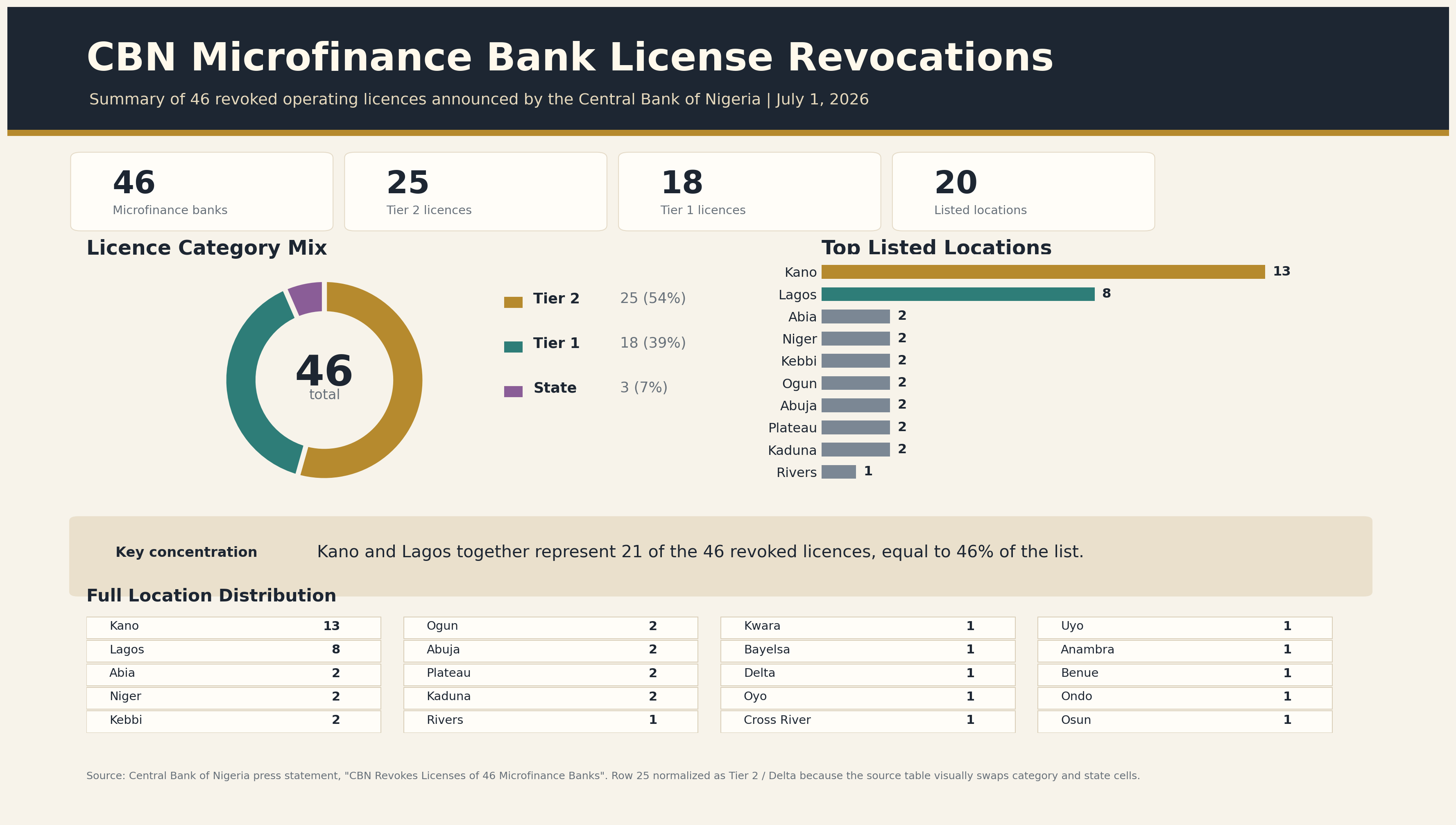
Effective today, the Central Bank of Nigeria revoked the operating licences of 46 microfinance banks under Sections 12 and 13 of BOFIA 2020, approved by Governor Cardoso. The stated grounds: insufficient assets to meet liabilities, closure without CBN approval, inactivity and cessation of financial intermediation, failure to commence operations within 12 months of licence approval, and failure to maintain minimum capital funds unimpaired by losses.
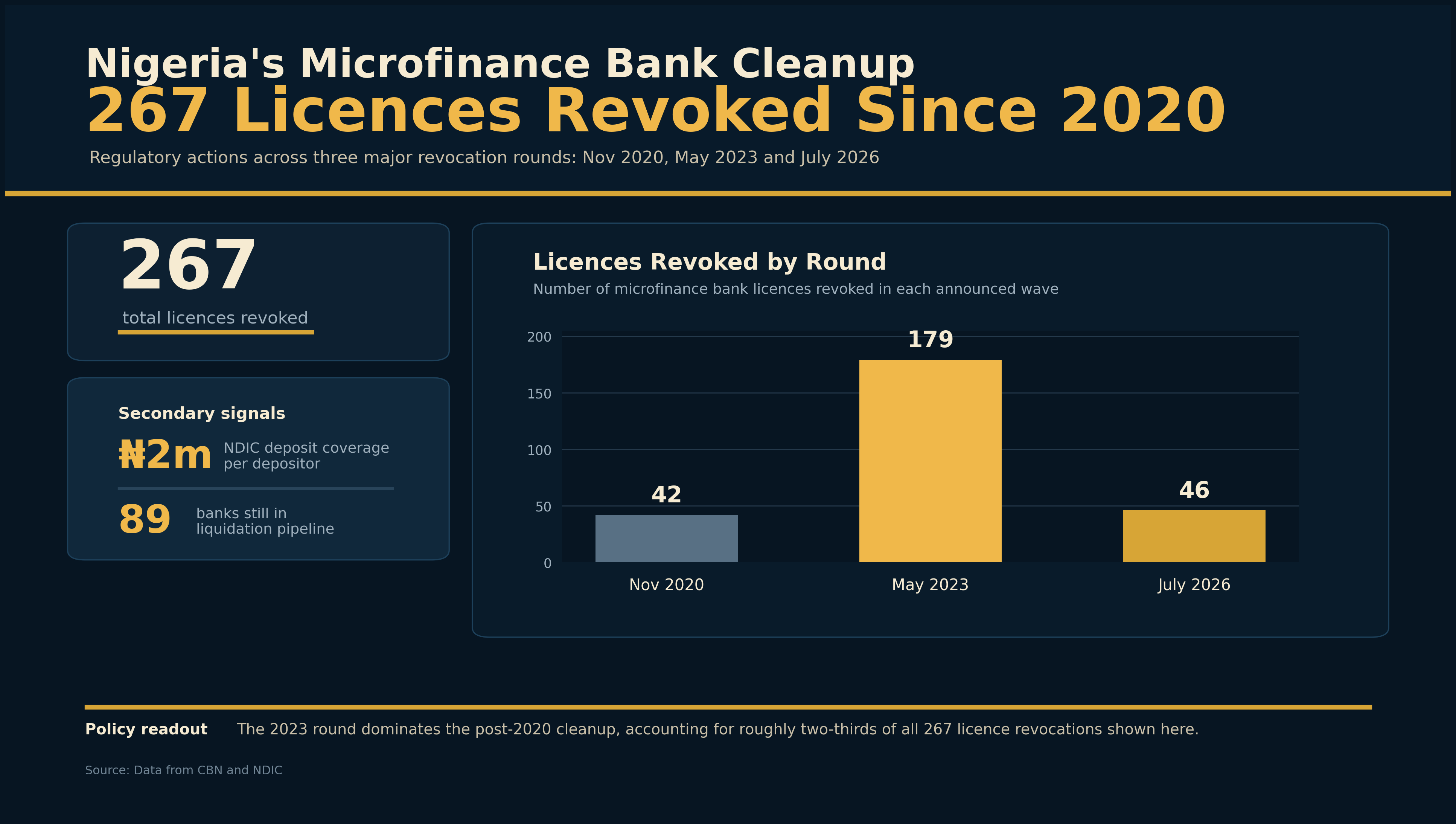
Why this isn't an isolated event. This is the second major MFB revocation in three years. In May 2023, the CBN revoked licences for 179 microfinance banks, after which the NDIC – as official liquidator – commenced depositor verification and payment across all 179 institutions. Today's action shows the supervisory intensity has not let up; it has become routine housekeeping rather than a one-off shock. Worth noting: as of April 2026, NDIC was still concluding the liquidation of 89 of those defunct banks from prior revocation cycles, with Purchase and Assumption arrangements involving newly licensed institutions. The resolution machinery is still digesting earlier cohorts even as today's 46 are added to the queue.
The bigger frame. This is happening alongside, not instead of, the commercial bank recapitalisation. The CBN's revised minimum capital requirements – ₦500bn for international banks, ₦200bn for national banks, ₦50bn for regional banks – concluded on 31 March 2026, with 33 banks meeting the requirements and raising a combined ₦4.65 trillion in fresh capital over the 24-month programme, with 72.55 percent of that capital domestically sourced. The MFB sector has had its own tiered thresholds since 2020 – ₦50m for Tier 2 unit players up to ₦5bn for national MFBs. Read together, both tracks say the same thing: the Cardoso-era CBN is tightening the capital floor across every tier of the financial system simultaneously, not just at the top.
The tension worth sitting with. MFBs exist specifically to serve the unbanked and informal economy – the layer of Nigeria's economic pyramid that commercial banks do not reach. Every consolidation cycle that strengthens systemic soundness also shrinks the number of access points for that segment, and the exit costs land asymmetrically on depositors least equipped to absorb them. NDIC raised MFB deposit coverage from ₦200,000 to ₦2,000,000 per depositor in May 2024 – protecting 99.27 percent of MFB depositors by account count. But coverage by count is not the same as coverage by value. Informal traders and cooperatives who parked working capital in these institutions – sometimes well above the insured limit – face a real haircut.
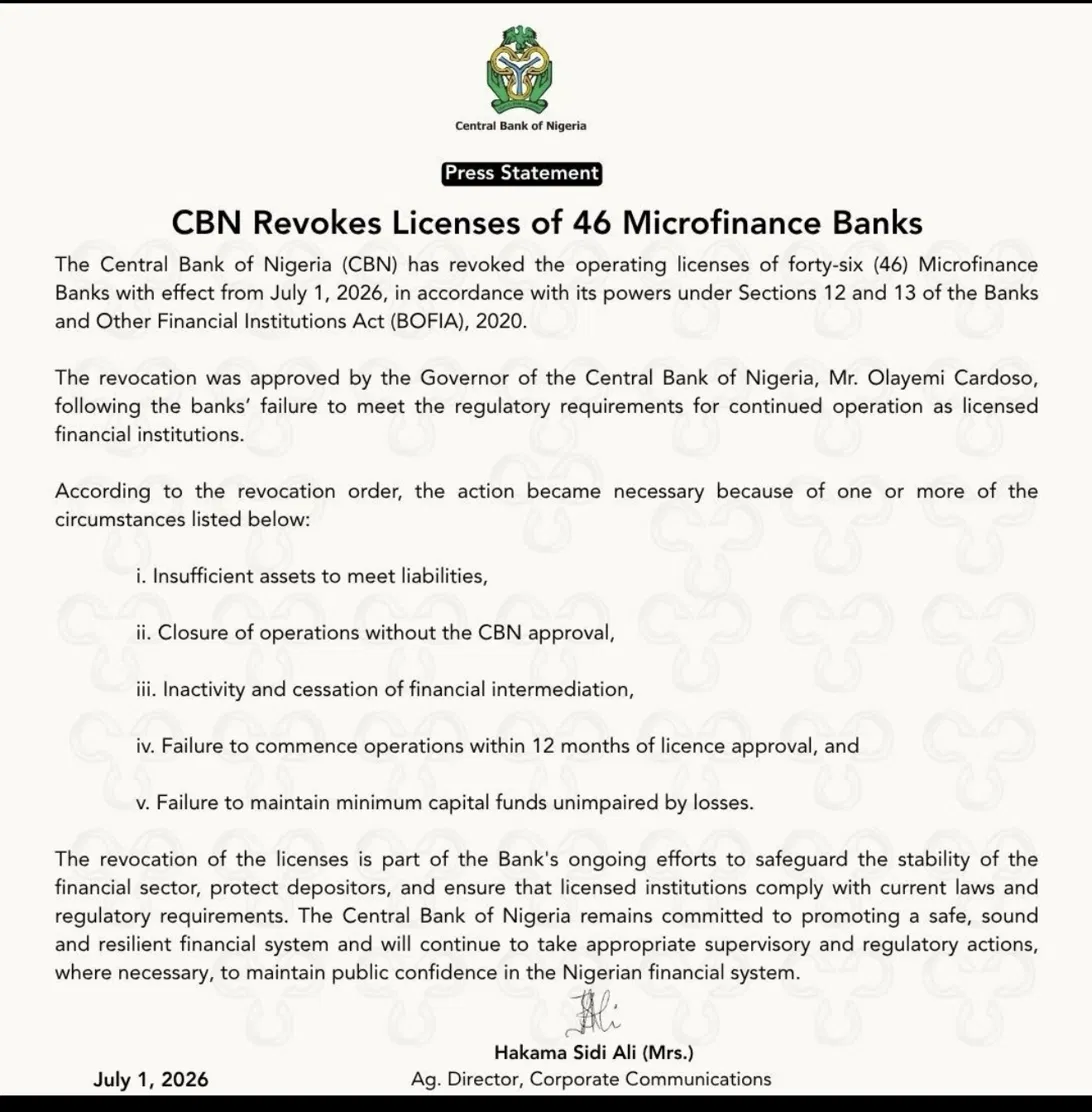
CBN Press Statement, 1 July 2026 (official)
NDIC Notice to Depositors of 179 Closed MFBs, May 2023 (official) — ndic.gov.ng
NDIC Deposit Insurance Coverage Increase, May 2024 (official) — ndic.gov.ng
SEC Nigeria Recapitalisation Policy Briefing, April 2026 (official) — sec.gov.ng
CBN Revised MFB Guidelines, 2020 (official) — cbn.gov.ng