As of July 1 2026, Nigeria's most significant overhaul of its trade and excise framework in three years is legally in force.
The 2026 Fiscal Policy Measures (FPM), contained in a circular signed by then-Finance Minister Wale Edun on 1 April 2026, introduce sweeping reductions in import duties across 127 tariff lines, a new green tax surcharge on large-engine vehicles, revised excise duties on beverages and tobacco, and import prohibitions on 17 product categories, replacing the 2023 framework that governed trade policy until now. The tariff reductions and import prohibition measures took effect from 1 April, with a 90-day grace period for importers who had opened Form M before that date. The excise duty and green tax components formally commence today. Implementation now falls to Taiwo Oyedele, who succeeded Edun as Minister of Finance and Coordinating Minister of the Economy on 21 April 2026.
What the tariff cuts actually mean
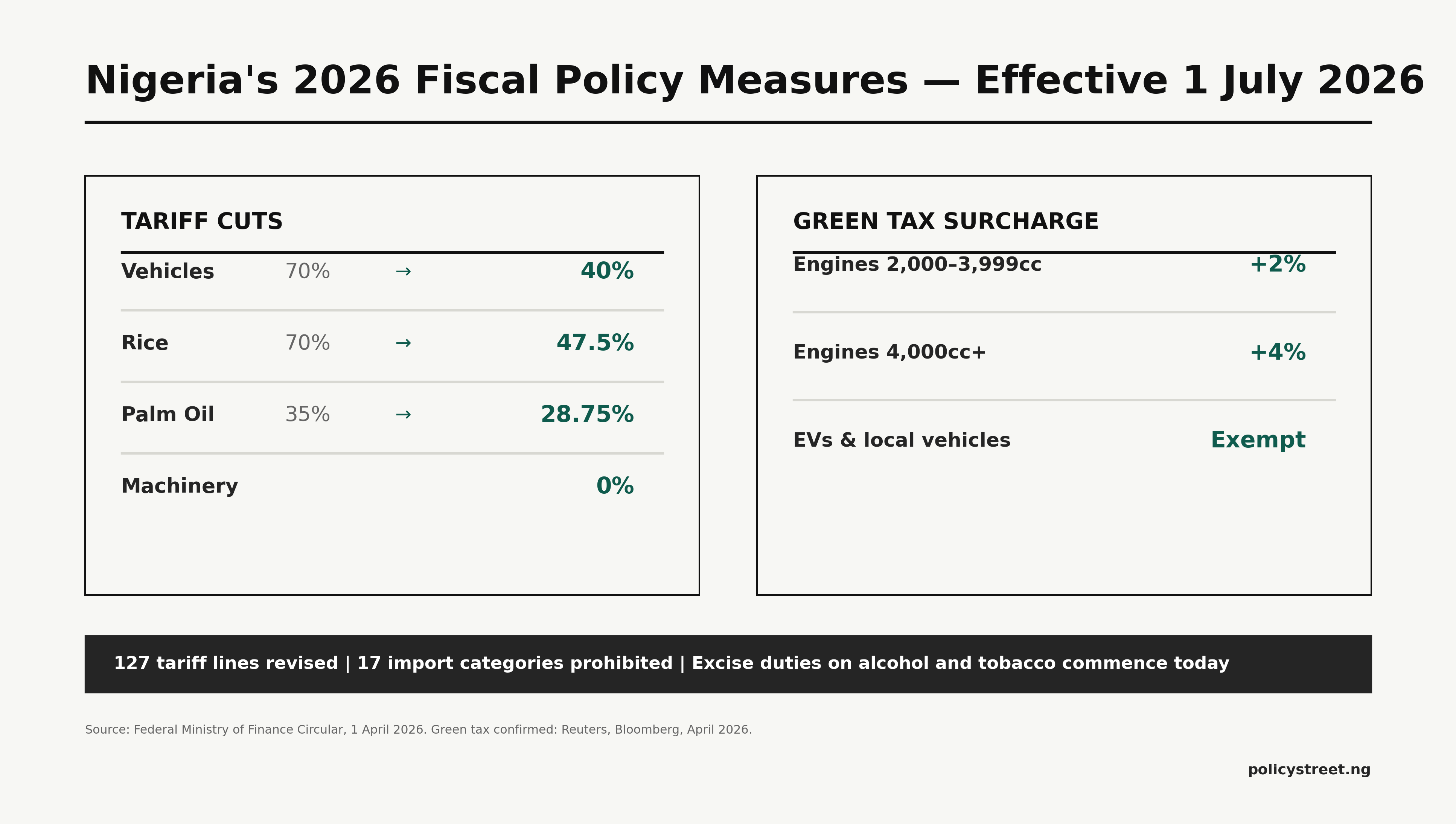
The FPM circular confirms the following duty reductions effective 1 April 2026: import duty on fully built passenger vehicles, including four-wheel drives and station wagons — cut from 70 percent to 40 percent; rice in bulk or packing above 5kg reduced from 70 percent to 47.5 percent; broken rice at 30 percent; crude palm oil at 28.75 percent, down from 35 percent. Zero percent import duty applies to railway locomotives in SKD/CKD form, cargo vessels above 500 tonnes, agricultural and manufacturing machinery, and safety equipment.
Alongside the reductions, the circular simultaneously imposes an Import Adjustment Tax on 192 tariff lines and prohibits imports of 17 product categories originating from non-ECOWAS countries, including refined vegetable oils, bagged cement, processed tomatoes, fertilisers, and certain pharmaceuticals. From January 2027, all Import Adjustment Taxes, except those on the AfCFTA 3 percent list, will begin phasing down annually until full elimination by 2036. The net effect is more nuanced than the headline cuts suggest: the package is simultaneously liberalising and protectionist, depending on which product and which trade partner you are looking at.
The green tax: targeting the fuel-guzzlers
Today also marks the commencement of Nigeria's first formal green tax surcharge on motor vehicles, confirmed in the FPM circular. Vehicles with engine capacity of 2,000cc – 3,999cc attract an additional 2 percent surcharge; those of 4,000cc and above face 4 percent. Vehicles below 2,000cc, mass transit buses, electric vehicles, and locally manufactured vehicles are exempt.
The design logic is clear – a Pigouvian tax using price signals to steer consumption toward lower-emission choices, while shielding smaller engines and promoting EV adoption. Whether it will work in a country where the second-hand vehicle market dominates and formal enforcement at the retail level remains patchy is a separate question. The policy sends the right signal. The implementation infrastructure to back it up is less certain.nairametrics
Excise duties: drinks, tobacco, and a public health debate
The FPM circular establishes a three-year excise schedule commencing today. According to reporting by multiple outlets citing the circular directly, the new specific rates are: beer and stout at ₦72 per litre in 2026, rising to ₦76 in 2027 and ₦80 in 2028; spirits at ₦75 per litre in 2026, stepping up to ₦85 by 2028, alongside a 30 percent ad valorem component; wines at ₦70 per litre plus 25 percent ad valorem; non-alcoholic beverages including juices, energy drinks and sugar-sweetened drinks at ₦10 per litre flat across all three years; and cigarettes at ₦6.00 per stick in 2026, rising to ₦7.00 in 2027 and ₦8.00 in 2028, with a 30 percent ad valorem component.vinetur
The tobacco rates have attracted pointed criticism from official civil society. In a formal statement, the Civil Society Legislative Advocacy Centre (CISLAC) noted that the annual increment of ₦1.00 per stick represents approximately a 13 percent nominal increase, below the prevailing inflation rate, meaning tobacco taxation is being weakened as a deterrent in real terms. CISLAC further stated that even by 2028, Nigeria's cigarette excise would achieve less than 30 percent of the ECOWAS-recommended benchmark of the equivalent of $0.40 per pack. guardian
In a large alcohol market where imported spirits and locally produced beers compete for price-sensitive consumers, higher excise duties may also drive some demand toward informal channels – a well-documented risk when sin taxes are implemented without matching enforcement capacity.
The tension worth watching
There is a structural tension at the heart of this package. The government is cutting tariffs on vehicles while introducing a green surcharge on large engines. It is raising excise duties on beverages at a moment when household incomes remain under pressure from two years of structural adjustment. And it is liberalising imports on some goods while prohibiting imports of 17 product categories from non-ECOWAS sources in the same circular. research.hktdc
According to reporting by Vanguard and S&P Global, rice farmers and auto sector operators have raised concerns that tariff reductions could intensify import competition and threaten domestic production and employment. The government's position – that lower input costs will ultimately strengthen domestic industries – is theoretically coherent but historically contested in Nigeria's policy environment.
The World Bank has noted that Nigeria is accelerating implementation of the AfCFTA through tariff liberalisation and digital trade reforms, describing it as a meaningful step toward unlocking regional trade and economic growth. The 2026 FPM is, in many respects, the most systematic attempt in recent years to bring Nigeria's trade and excise architecture into regional alignment while using fiscal tools to pursue both growth and social objectives. Whether implementation holds — and whether the revenue and behavioural outcomes materialise – is the story to watch across the second half of 2026. blogs.worldbank
Sources: Federal Ministry of Finance Circular, 1 April 2026 (official); HKTDC Research – Nigeria: Tariff and Excise Framework Revision, April 2026; CISLAC Tobacco Tax Statement, April 2026 (official civil society); World Bank Trade Blog, June 2026; Reuters, April 2026. Excise duty figures per multiple outlets citing the FMF circular directly.