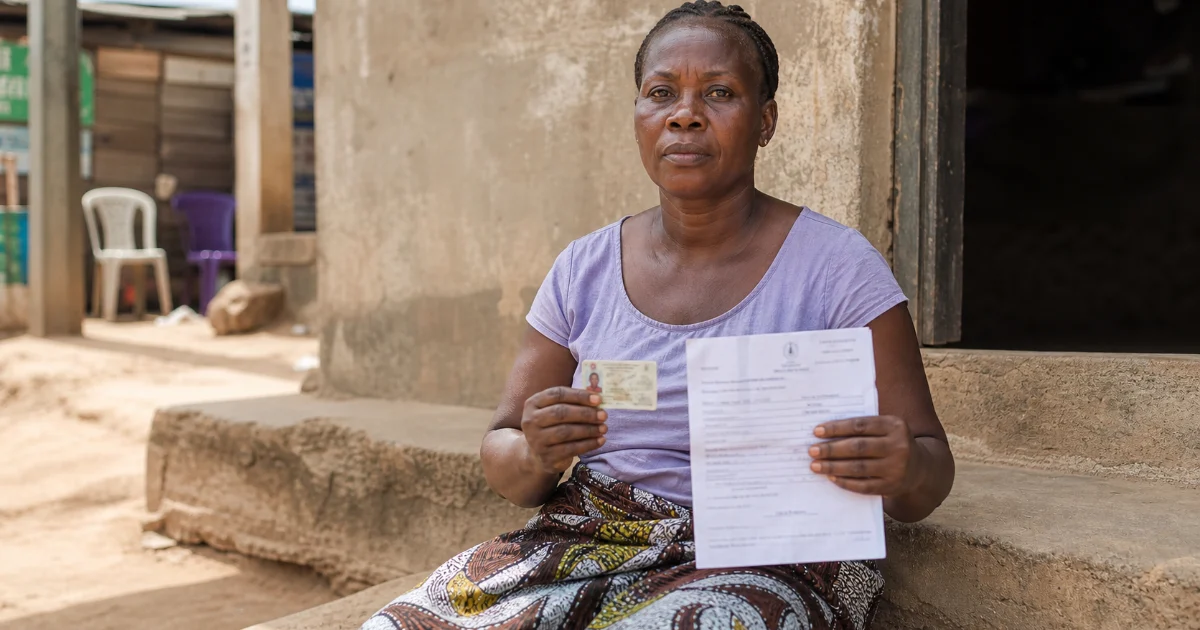
Nigeria launched the National Poverty Intelligence Lab (NPIL) on 24 June 2026, a data platform designed to track, monitor, and evaluate poverty reduction programmes targeting the estimated 140 million Nigerians – roughly 63% of the population – living below the poverty line. The lab was unveiled by the Minister of Humanitarian Affairs and Poverty Reduction, Dr Bernard Doro, at a three-day operationalisation workshop in Abuja, in partnership with Innovations for Poverty Action (IPA), a global research and policy organisation that has operated in Nigeria since 2019 across sectors including social protection, financial inclusion, and agriculture.
The poverty figure itself is striking and needs context. According to the World Bank's Nigeria Development Update published in April 2026, Nigeria's poverty rate rose from 56% in 2023 to 61% in 2024 and reached 63% in 2025, despite a slowdown in inflation over the same period. The World Bank attributed this to weak income recovery – macroeconomic indicators have improved, but those gains have not yet translated into real household welfare for most Nigerians.
The Minister framed NPIL as a direct response to an institutional failure he named openly: "For many years, our interventions have been driven by assumptions rather than evidence, sometimes by politics rather than data, and by silos rather than systems."
That framing, while accurate, does not fully capture the scale of the problem. Nigeria is not upgrading its poverty data infrastructure. It is building it for the first time in any systematic sense, despite having operated poverty programmes continuously since the 1990s.
The Evidence Problem: Decades of Blind Spending
Nigeria's poverty reduction architecture has included the National Poverty Eradication Programme, Conditional Cash Transfer schemes, the National Social Investment Programme, N-Power, and various state-level welfare schemes. These programmes have collectively absorbed substantial public resources across successive administrations. Yet as the Minister acknowledged at the NPIL launch, programme design and allocation decisions have rested on assumptions rather than empirical evidence of impact.
This is not a minor operational problem. It represents a fundamental breakdown in policy feedback loops.
The mechanism is straightforward. A government launches a poverty programme. Money is disbursed. Years later, policymakers make decisions about whether to continue, expand, or redesign it. Those decisions should rest on evidence of whether the programme actually reduced poverty, improved employment, or increased household income. Without measurement systems, that evidence does not exist and those decisions default to political and patronage considerations rather than technical ones. Resources flow to constituencies with political influence rather than regions with the greatest poverty depth, and there is no data-based challenge available.
The NPIL attempts to address this by creating standardised data collection, outcome tracking, and impact evaluation across poverty programmes.
What NPIL Actually Does – And Does Not
According to the Ministry, the lab will function as the "intelligence backbone" of Nigeria's poverty reduction architecture, providing analytical support for policy formulation, programme implementation, resource allocation, and performance assessment. It will support the One Humanitarian One Poverty Response System (OHOPRS), a framework designed to harmonise humanitarian assistance, social protection, and poverty reduction under a unified structure.
In technical terms, that means three things:
Targeting: Identifying who is poor using standardised definitions so that programmes reach the right people.
Monitoring: Tracking programme implementation and whether intended beneficiaries are actually being reached.
Evaluation: Measuring whether interventions produce the outcomes they were designed to produce.
This is sound poverty programme infrastructure. IPA has built similar evidence labs in other countries – including a Human Trafficking Embedded Evidence Lab with Nigeria's NAPTIP – and brings established methodologies for randomised evaluations and embedded evidence systems. IPA Nigeria's Country Representative, Fumi Ayeni, described the collaboration as one that will "help policymakers build a legacy that can significantly reduce poverty in Nigeria" by improving targeting and reducing duplication across programmes.
The critical constraint is not design but implementation. Data quality depends on programme staff reporting accurately. Outcome measurement requires follow-up surveys of beneficiaries, which are expensive and administratively complex. Political pressure to report success can distort findings. And technical analysis must translate into actual policy changes, which requires political willingness to reallocate resources away from ineffective programmes.
Why Was This Infrastructure Missing?
The absence of evaluation infrastructure for decades of poverty spending is not accidental. It reflects several institutional realities.
Fiscal trade-offs. Poverty evaluation requires dedicated budgets for surveys, data staff, and technical analysis – ongoing costs competing with programme delivery. In a resource-constrained environment, governments have historically chosen visible spending over invisible measurement.
Political risk. Rigorous evaluation creates accountability. If data shows a flagship programme is ineffective, political figures who championed it face pressure to defend or abandon it. Many policymakers prefer ambiguity to measurement.
Technical capacity. Designing rigorous poverty evaluations requires economists and statisticians with specialised training. Nigeria's civil service has historically struggled to retain such talent against private sector and international competition, which is directly why the NPIL partnership with IPA is necessary rather than optional.
Donor dependence. The IPA partnership signals that Nigeria's government could not have built this alone. That is pragmatic and honest, but it also reveals capacity gaps that the NPIL itself will need to help address over time.
The Three Tests Ahead
NPIL's value will be determined by whether three conditions hold.
The first is data quality. If programme staff report inflated beneficiary numbers or falsify outcomes to appear successful, the platform generates misinformation rather than intelligence. The Ministry and IPA have signalled that a Monitoring, Evaluation, Learning and Data Systems Diagnostic Exercise is underway to identify institutional gaps and build an integrated national evidence system – this is the foundation on which data integrity will rest.
The second is whether findings drive decisions. If rigorous evaluation shows Programme A is ineffective and Programme B is producing results, does the government reallocate resources toward B – or do political constituencies preserve Programme A regardless of evidence? The lab produces data; policymakers decide what to do with it. Minister Doro's language was direct: "The NPIL changes that. It gives us the analytical infrastructure to ask the right questions, find credible answers and hold ourselves accountable for results." That accountability will be tested the first time evaluation findings conflict with political convenience.
The third is sustainability. Government data infrastructure projects frequently collapse once donor funding ends or political attention shifts. Long-term integration into budget cycles and administrative systems – rather than existence as a standalone project – is essential.
Why It Matters Beyond Poverty
For fiscal efficiency, better targeting and evaluation could improve outcomes per naira spent on social programmes, and provide a basis for redirecting resources from ineffective to effective interventions.
For financial policy, the World Bank's April 2026 Nigeria Development Update made explicit that macroeconomic gains – lower inflation, modest GDP growth – are not reaching household incomes. Better poverty data improves the government's understanding of where and why macro-level improvements are failing to transmit to household welfare, which is relevant to both fiscal and monetary policy design.
For institutional credibility with multilateral partners, the IMF and World Bank track whether countries have evidence infrastructure for evaluating public spending. NPIL signals that Nigeria recognises this gap. Implementation will determine whether that signal is credible.
Sources: Punch, 25 June 2026; World Bank Nigeria Development Update, April 2026; IPA Nigeria Country Programme Brief, February 2024; Ministry of Humanitarian Affairs launch statements, 24 June 2026; Nairametrics, April 2026.