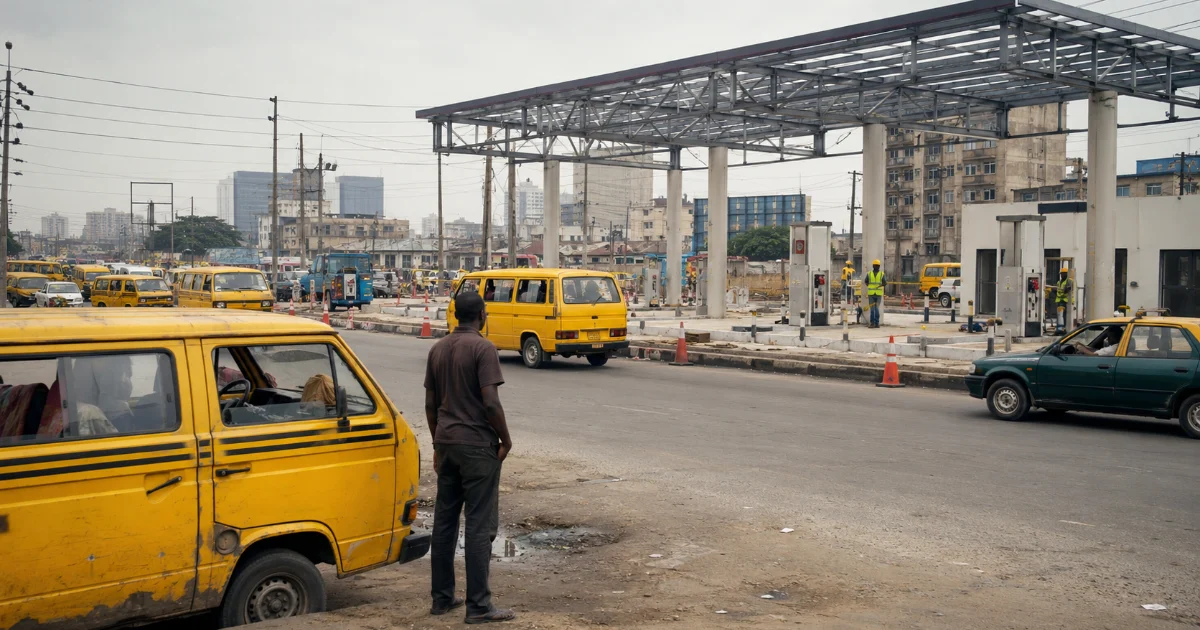
Nigeria’s compressed natural gas (CNG) plan rests on a simple numerical problem. The Federal Government wants 2,322 CNG stations in place by 2027, but today the network is counted in dozens, not thousands. Bridging that gap, and helping drivers actually use the new fuel, will determine whether the programme delivers meaningful relief from high petrol prices or remains mostly aspirational.
Background: the CNG target
CNG is being promoted as a cheaper, cleaner substitute for petrol and diesel in road transport. The Presidential CNG Initiative sits at the centre of this policy. Public statements from the initiative and its partners point to several related targets:
Around 75 CNG refuelling stations are currently operational across about 20–28 states, up from a much smaller base a few years ago.
Earlier announcements spoke of 100–150 retail outlets by 2025 and 500 stations funded from the Midstream and Downstream Gas Infrastructure Fund.
More recent briefings from the initiative refer to a wider roll‑out, with roughly 2,000 to 2,500 retail outlets in view by 2027, depending on how “mother”, “daughter” and integrated stations are counted.
In parallel, the government has set a headline goal of converting around one million vehicles to CNG by 2027, up from tens of thousands of conversions in 2024. The logic is straightforward: if more vehicles switch to gas and there are enough places to refuel, the transport sector can shift part of its demand away from imported petrol towards domestically produced gas.
Infrastructure gap
From first principles, a fuelling network must reach three basic conditions before most drivers consider a fuel usable:
Coverage – stations within a reasonable distance of where people live, work and travel.
Capacity – ability to handle daily demand without long queues.
Reliability – predictable opening hours and consistent supply.
Current figures show a network still in its early stages. Industry assessments around 2025 reported about 27 “mother” stations and 63 “daughter” stations serving as CNG outlets, with regional gaps especially in the North and South‑East. Government updates in 2026 speak of roughly 75 operational stations across 20 states.
Against a target of over 2,000 stations, this implies:
A large build‑out still ahead, even if existing projects under construction are completed.
A need to spread infrastructure beyond a few urban corridors so that benefits are not confined to Lagos, Abuja, Kano and a handful of other centres.
In simple terms, the map is still thin. For many drivers, especially outside major cities, the combination of long distances between stations and uncertainty about supply will limit willingness to switch.
Vehicle conversion economics
Station numbers alone do not change fuel usage patterns. Vehicles must be able to run on CNG. That requires kits and installation work.
Available estimates put typical conversion costs at:
Cars and SUVs: around ₦300,000 to ₦500,000 per vehicle.
Commercial buses: often higher, in the ₦600,000 to ₦900,000 range.
Tricycles (keke): roughly ₦180,000 to ₦250,000.
These figures are sensitive to exchange rates because most kits are imported, and reports in late 2024 noted that some conversions had become more expensive as the naira weakened.
For a household or small transport operator, these sums are significant. The basic calculation they face is:
Upfront cost today vs.
Expected fuel savings over a period of months or years.
Some analyses suggest that, at current price differentials, owners could recover conversion costs within 6–12 months if they drive heavily. However, this assumes:
Stable gas pricing;
Consistent access to CNG stations;
No major maintenance issues with the kit.
Without easy credit, grants or subsidised kits, many low‑income drivers will struggle to make the initial payment, even if the long‑term economics look favourable on paper.
Policy instruments in play
To address these gaps, the Federal Government has used a mix of instruments:
Capital subsidies and funds – the Midstream and Downstream Gas Infrastructure Fund has supported new stations and related infrastructure, while the Presidential CNG Initiative reports over 2 billion dollars of private investment drawn into the CNG space by 2025.
Targeted kit support – announcements have referenced free or subsidised conversion kits for public transport fleets, with directives for large‑scale deployment to ease transport costs.
Concessional gas pricing – some reports point to efforts to keep mobility gas prices relatively low to preserve the cost advantage over petrol.
Even so, progress has been uneven. Monitoring by analysts and the press has noted that station roll‑out has lagged earlier interim targets despite committed investment, raising questions about project execution, permitting, and local constraints.
Distributional and regional issues
A fair assessment must also consider who is likely to benefit first and who may be left behind.
Urban vs. rural – early stations are concentrated in major cities and along busy routes. Rural and peri‑urban areas may see slower coverage, limiting the reach of any cost relief.
Large vs. small operators – large fleet owners can spread conversion costs across many vehicles and may access better financing terms. Informal or small‑scale operators, including single‑vehicle owners, face more difficulty.
Regional balance – uneven pipeline networks and higher distribution costs in some regions make it harder to deploy CNG there at competitive prices.
If these patterns persist, the programme could deepen differences between regions and between formal and informal operators, even while improving conditions for those who can access the new system.
What would make the target more credible
Reaching 2,322 stations and broad vehicle adoption by 2027 would require progress on several fronts:
Clear, sequenced infrastructure plan – a transparent list of locations, timelines and developers, with public tracking of completion and delays.
Stable and predictable gas pricing – enough to keep CNG cheaper than petrol while giving investors confidence to finance stations.
Scaled financing for conversions – loans, pay‑as‑you‑save schemes or grants targeted at commercial drivers and low‑income households, so that up‑front costs do not exclude most of the intended beneficiaries.
Technical capacity – training and certifying more conversion technicians and workshops, to maintain safety and quality as volumes grow.
Reliable regulatory support – clear standards for equipment and operations, and consistent enforcement to build user confidence.
Conclusion
The government’s ambition for more than two thousand CNG stations by 2027 reflects a desire to shift part of road transport away from expensive petrol towards domestic gas. The current base — roughly a few dozen to several dozen operational stations and a small share of vehicles converted — shows how far there is to go.
CNG can lower running costs for drivers who can both refuel conveniently and afford conversion. The central challenge is that these two conditions are not yet widely met. Without a faster build‑out of stations and practical ways to spread or reduce conversion costs, the gains will arrive slowly and unevenly, with early benefits skewed towards better‑resourced operators in major cities.