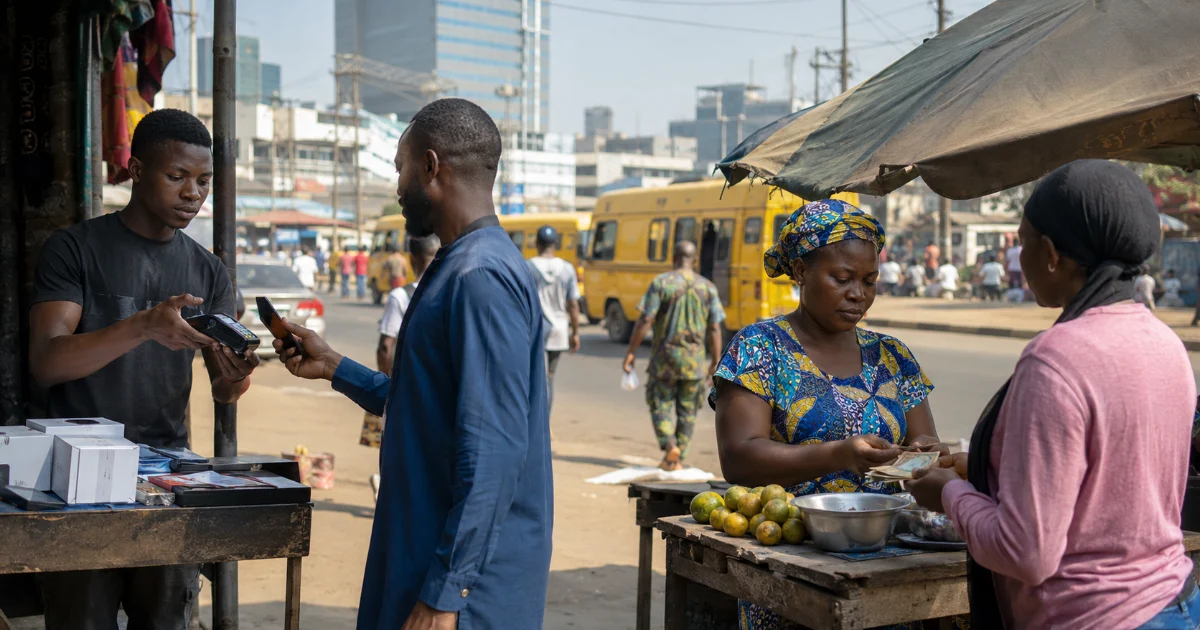
Nigeria now moves more than ₦1 quadrillion a year through electronic payments, based on Nigeria Inter‑Bank Settlement System (NIBSS) data for 2024.
That means money sent by bank transfer, card, mobile app, internet banking and POS terminals has become part of daily economic life. For many Nigerians, paying without cash is no longer unusual. It is how shops sell, families send money, workers receive payments and businesses stay open.
But the same country still has millions of adults who cannot fully take part in this system.
According to NIBSS data cited in recent reports, the total value of electronic payment transactions rose from about ₦387–₦395 trillion in 2022 to around ₦600–₦611 trillion in 2023, then to about ₦1.07 quadrillion in 2024. Early industry estimates suggest that the value approached around ₦1.2 quadrillion in 2025, though full official numbers have not yet been widely published.
That is a major milestone.
Yet Enhancing Financial Innovation & Access (EFInA)’s 2023 Access to Financial Services survey shows that 26% of Nigerian adults – about 28.8 million people – remain completely excluded from the financial system. In simple terms, they do not have access to the kind of banking, wallet or regulated financial services that allow people to save, send, receive or manage money safely through the formal system. Nigeria’s Payments System Vision (PSV) 2028 uses this exclusion figure as a starting point and sets new targets to reduce it.
So Nigeria has two stories happening at once. One story is about speed, scale and innovation. The other is about exclusion.
Why the big payment number matters
A payments system is like the road network of an economy. If the road is fast, safe and widely connected, trade becomes easier. People can buy and sell with less friction. Businesses can receive money faster. Government payments can be tracked. Families can send support without waiting for cash to travel physically.
That is why Nigeria’s digital payment growth matters.
It shows that more economic activity is moving through formal channels. It also shows that Nigerians are already comfortable using digital tools when those tools work.
For a small business in Lagos, Abuja, Port Harcourt or Enugu, this is practical. A customer may not carry cash. A trader can use POS. A freelancer can receive a bank transfer. A shop that cannot accept digital payment may lose customers.
But that is only one side of the economy.
Why exclusion still matters
For a small trader in a rural community, the story may be different.
The nearest agent may not have enough cash. The network may fail. The POS machine may not work because there is no power. A failed transfer may take too long to reverse. Charges may appear without clear explanation. A person who has been defrauded once may return to cash and never trust the system again.
This is why financial exclusion is not just about not having a bank account.
It is about whether people can reliably use the system when they need it.
A payment system is only truly national when it works for the market woman, the student, the farmer, the rural trader, the small business owner and the low-income household — not just for people in cities with smartphones and stable networks.
Where the gap is widest
PSV 2028 notes that financial inclusion has improved overall, but not evenly, drawing on EFInA and National Financial Inclusion Strategy data rather than new CBN surveys of its own.
The strongest growth has been in urban areas and southern states, while exclusion remains much higher in parts of the North-East and North‑West, where rural communities still face weak agent coverage, poor connectivity and security problems.
There is also a gender gap.
EFInA estimates that more than 21 million women remain outside the financial system, with exclusion concentrated among rural, low‑income and less educated women. The reasons include lower phone ownership, literacy barriers, income instability and social norms that limit women’s control over money. PSV 2028 explicitly recognises closing this gender gap as one of its objectives.
This matters because payment access is no longer a side issue. It affects trade, savings, welfare payments, credit access and economic participation.
When people are outside the payments system, they are often outside many other opportunities as well.
What the CBN wants to change
The CBN’s Payments System Vision 2028 sets a target of raising formal financial inclusion to about 95% of adults by 2028, which it frames as bringing around 50 million additional Nigerians into the system.
That means the goal is not just to process more money digitally. The goal is to bring more people into the system.
The plan includes expanding agent banking, improving wallet access, supporting women agents, and making payment services more available across local government areas.
It also includes offline payment options. This matters because many communities do not have reliable internet or electricity. If digital payments only work when the network is strong, then millions of people will remain dependent on cash.
The CBN also wants to expand QR and NQR payments to millions of merchant outlets by 2028, including a target of around 5 million merchants mentioned in commentary on PSV 2028. In plain English, this means more small businesses should be able to receive payment by scan or simple digital code, not only through expensive hardware.
There is also a push for financial literacy through schools, NYSC, community roadshows and local-language campaigns.
That part is important. People cannot trust what they do not understand. And they cannot use safely what has not been explained to them.
The real test
The hard part is not writing the target. It is delivering it.
Nigeria has set ambitious inclusion targets before and missed them. The same problems keep returning: poor connectivity, unreliable agents, hidden charges, weak complaint systems, low literacy and fraud.
PSV 2028 recognises these problems clearly.
It notes that broadband penetration remains below 50%, highlighting connectivity as a critical bottleneck. It points to how power outages disrupt POS terminals and USSD sessions. It also acknowledges user complaints about unexpected fees and weak redress systems, where customers struggle to get quick refunds or clear answers when transactions fail.
These are not small technical issues.
For a low-income user, a failed transaction can mean no food purchase, no transport fare, no school payment or no trust in the system again.
That is why reliability matters as much as innovation.
Summary
Nigeria’s quadrillion‑naira digital payments milestone is important. It shows that the country has built a large and active payments system.
But a payments system should not be judged only by how much money passes through it.
It should also be judged by who can use it, who trusts it, who is protected when something goes wrong, and who is still left outside.
PSV 2028 identifies the right problems: access, trust, agent liquidity, connectivity, literacy, gender exclusion and consumer protection, drawing on EFInA, NIBSS, CBN and other data.
The question now is whether implementation will be different from previous strategies.
Nigeria has already shown that people will use digital payments when the system works. The next challenge is to make it work for the people who have been hardest to reach.
The country has crossed the quadrillion‑naira line. The more important test is whether the system can cross the last mile.