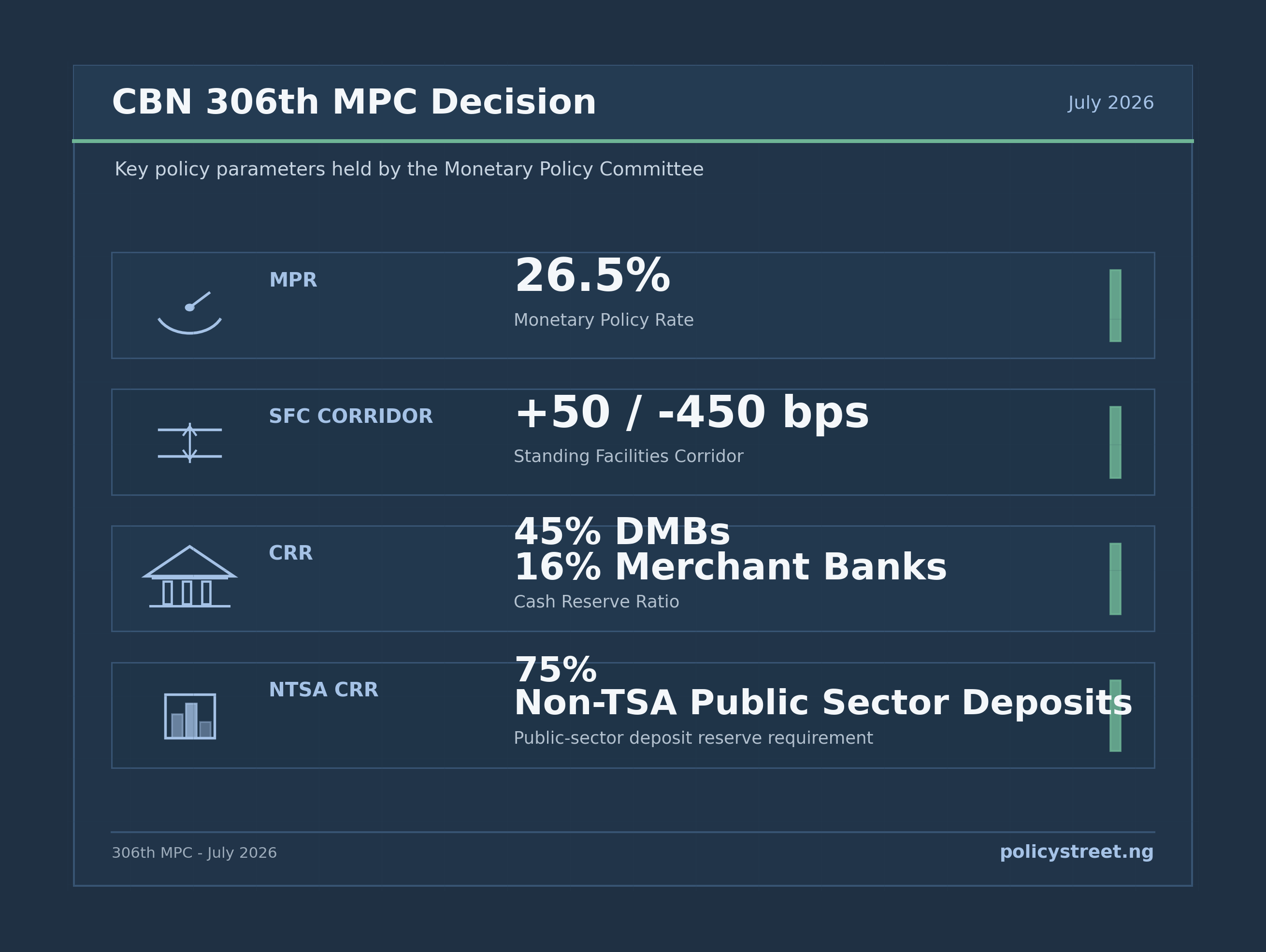
The 306th meeting of the Central Bank of Nigeria’s Monetary Policy Committee has ended with no change in interest rates. The Monetary Policy Rate stays at 26.5 per cent, and all other key settings remain the same.
All eleven members of the committee met in Abuja on 20 and 21 July 2026. Governor Olayemi Cardoso announced the decision on Tuesday afternoon. He said the committee chose to retain the current stance after reviewing recent data on inflation, growth and the global economy. The Cash Reserve Ratio stays at 45 per cent for deposit money banks and 16 per cent for merchant banks, the CRR on non‑TSA public‑sector deposits remains 75 per cent, and the Standing Facilities Corridor is unchanged at +50/‑450 basis points around the policy rate.
Markets expected this outcome. Local banks, research houses and international analysts all projected a hold going into the meeting. The CBN had already paused in May after cutting the policy rate by 50 basis points in February, following an earlier 50‑basis‑point cut in September 2025. In total, it has reduced rates by one percentage point from the 2025 peak, then kept them steady at the last two meetings.
That does not make this decision irrelevant. It tells us how the committee is reading inflation, external risks and the room for any further easing this year.
The CBN’s own test, revisited
In May, Governor Cardoso and other MPC members put more weight on short‑term inflation trends, the drivers of those trends, and the external environment. They signalled that any further cut would depend on clear evidence that inflation was slowing in a durable way and that the main shocks were fading rather than intensifying.
The latest data are mixed. Headline inflation eased only slightly in June, to about 15.9 per cent year‑on‑year from 15.93 per cent in May, while food inflation accelerated. That is a small improvement in the headline number, paired with ongoing pressure on food prices. For a committee that says it wants a “clear disinflationary path”, this combination does not offer strong grounds for another cut.
On that reading, today’s hold is consistent with the framework the CBN set out in May. A modest decline in headline inflation, with food prices still rising quickly and significant uncertainty abroad, points to staying put rather than moving again now.
What has changed since the last meeting
Two developments since May matter for how we should read this decision.
The first is the shift in external risk. The escalation of conflict in the Middle East has renewed concerns about global energy prices, and Nigerian fuel prices are still closely linked to developments in dollar‑denominated oil markets. In response, Standard Chartered has revised its Nigeria rate outlook: it now expects no policy easing in 2026, and projects that the first cut after this pause will come in March 2027, with a sizable 250‑basis‑point reduction. That is a sharp change from its earlier view that the CBN would cut by 150 basis points this year.
The second is the political and fiscal calendar. Nigeria is moving closer to the 2027 general elections. Election cycles often bring higher public spending and larger transfers to the tiers of government through the Federation Account, especially when oil revenues are stronger. Higher fiscal outlays can add liquidity to the system that the CBN then has to absorb through open‑market operations and other tools if it wants to keep monetary conditions tight. Keeping the policy rate unchanged while actively managing liquidity through these operations is, in effect, the stance the Bank is now taking.
Both of these factors – external risk and domestic politics – support a longer pause than many expected at the start of the year.
The easing cycle: started, then put on hold
The CBN’s easing cycle is real, but very limited so far. After a tightening phase that took the policy rate to about 27.5 per cent, the MPC cut by 50 basis points in September 2025 and by another 50 basis points in February 2026. It held in May and has now held again in July.
If Standard Chartered’s new projection is roughly right, this means the Bank will have delivered 100 basis points of cuts and then held rates steady for more than a year. At the start of 2026, many investors expected 300 to 500 basis points of easing over the course of the year. The gap between those expectations and current reality is large.
The main reasons are clear. The inflation slowdown has been weaker and less even than hoped, food prices remain high, and external risks have increased rather than faded. In that context, the CBN has chosen to keep a tight policy stance, protect the currency and wait for firmer evidence that inflation is on a safer path.
That approach is defensible from a narrow inflation and exchange‑rate perspective. It is also painful for firms and households that still face very high borrowing costs and real incomes that have not yet fully recovered from recent reforms.
What to watch between now and September
The next MPC meeting is scheduled for 21 and 22 September 2026. Three things will shape whether that meeting becomes a real opening for another cut, or simply another hold
Inflation data.
The July consumer‑price figures, due in mid‑August, will show whether June’s small decline in headline inflation was the start of a clearer downward trend or just noise. If both headline and core inflation slow convincingly on a month‑on‑month basis, the case for discussing a cut in September becomes stronger. If food inflation continues to rise and headline inflation stalls, the case weakens.External conditions.
The path of the Middle East conflict and global energy prices will influence Nigeria’s inflation and FX position. A calmer external environment would support the argument for easing; a worsening one would reinforce the case for staying on hold.Fiscal and liquidity conditions.
As the election cycle advances and FAAC allocations reflect oil receipts and budget implementation, we should expect more fiscal injections into the economy. How the CBN responds – through open‑market operations, use of the Standing Facilities, and other liquidity tools – will tell us how much effective tightening it is applying beyond the headline policy rate.
Watching these three areas will give a better guide to the September decision than the rate number alone.
In Sum
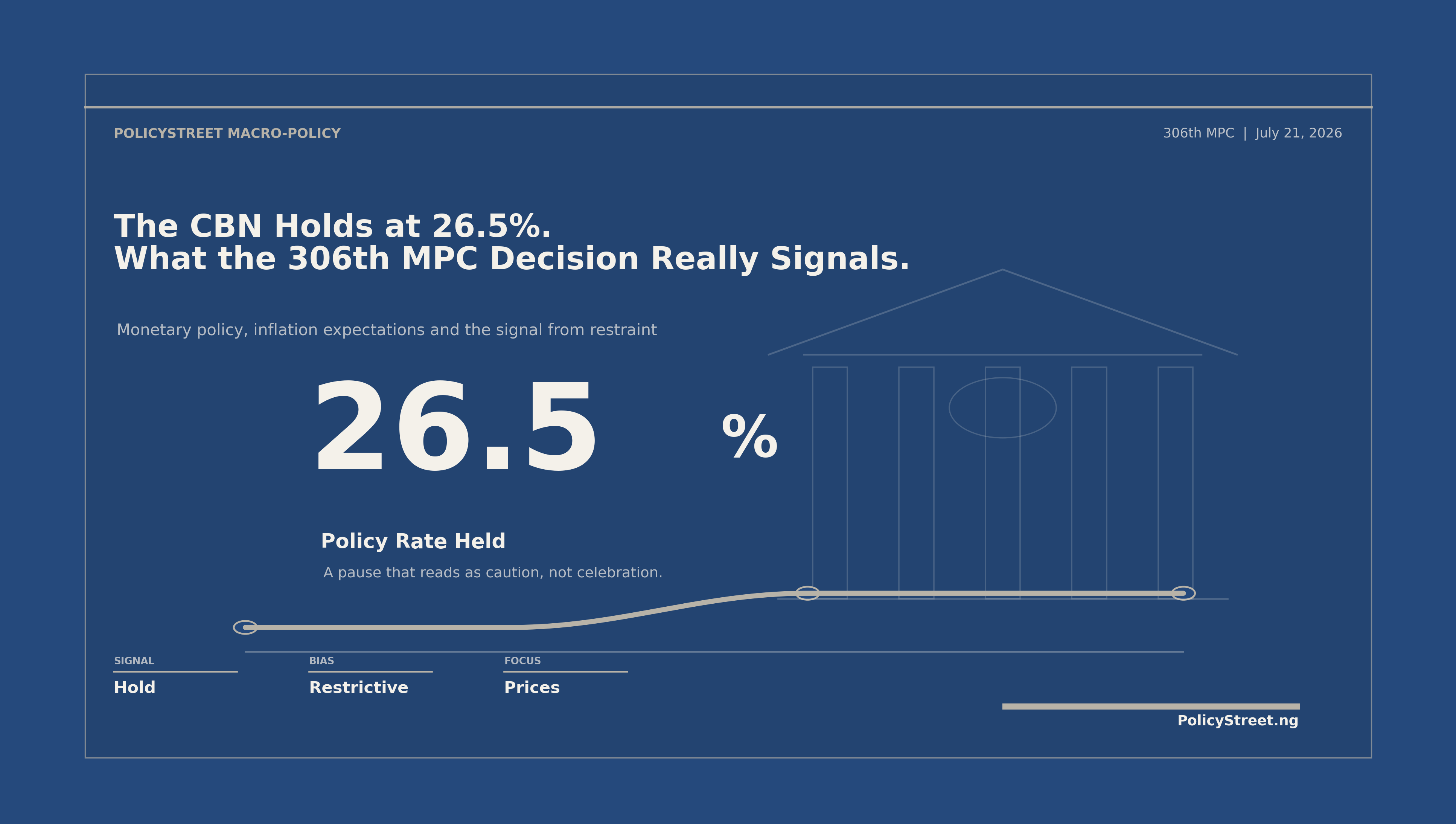
Today’s 306th MPC decision is in line with expectations. The policy rate stays at 26.5 per cent, and the CBN continues to run a tight monetary stance. This matches the cautious approach it has taken since May and reflects modest progress on inflation, higher external risks, and a more demanding fiscal and political environment.
For now, the easing cycle is on hold. The earliest realistic window for another cut is September, and even that will depend on better inflation data, calmer global conditions and a manageable fiscal‑liquidity backdrop. If those conditions are not in place, the pause is likely to extend into the end of the year.
For businesses and households, that means borrowing costs will remain high for longer than many had hoped, and any relief will come later and more slowly than early‑2026 forecasts suggested. PolicyStreet will track each data release and official statement between now and the September meeting, and will publish a close reading of the full communiqué and personal statements once the CBN releases them.