
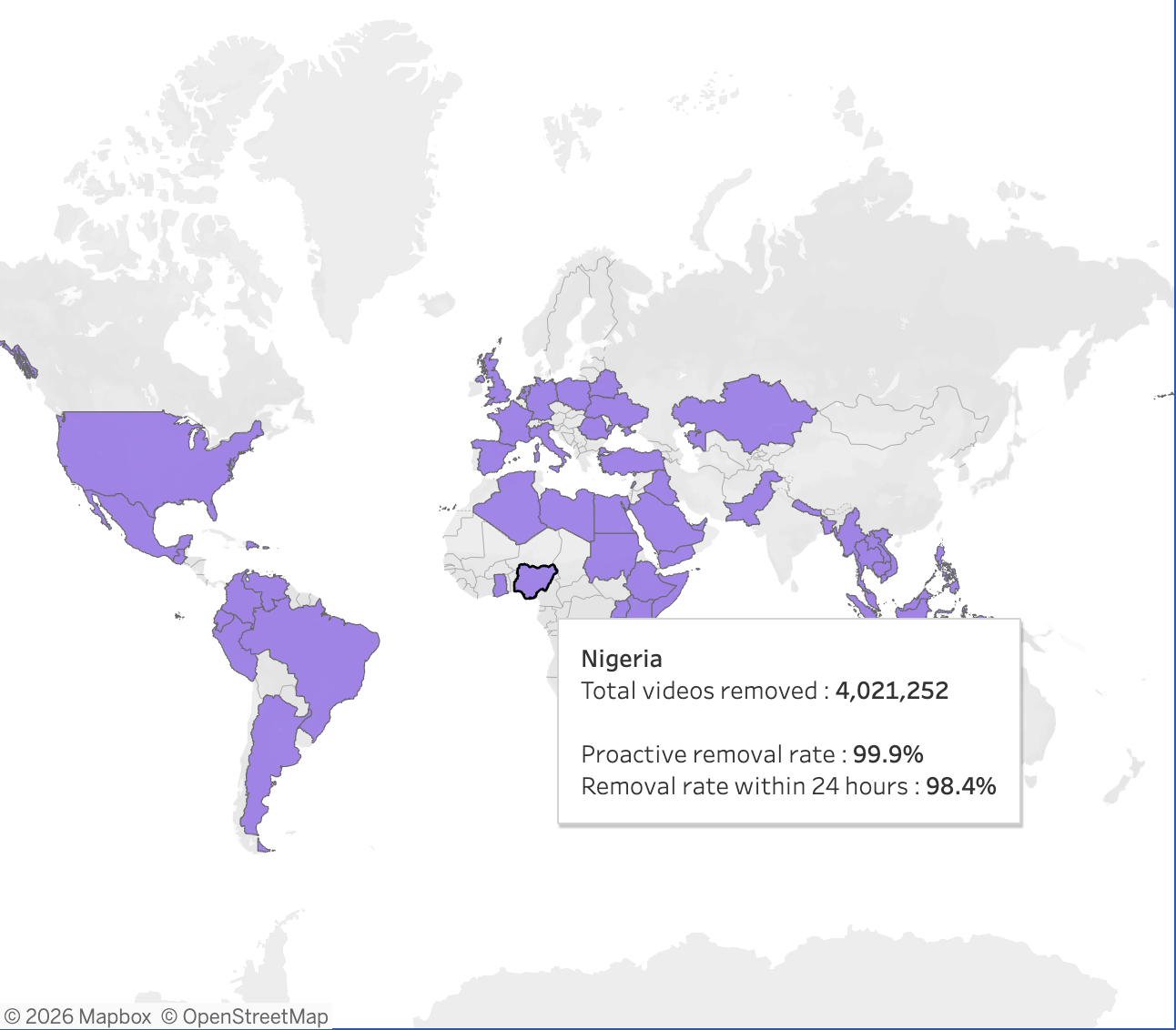
TikTok removed 4.02 million videos and terminated 86,000 live sessions in Nigeria during the fourth quarter of 2025, according to the platform's Community Guidelines Enforcement Report released this week. The enforcement actions underscore both the volume of content flowing through one of Africa's largest social media markets and the accelerating deployment of automated moderation systems to manage regulatory risk in a jurisdiction where the government has intensified scrutiny of digital platforms.
The Moderation Infrastructure: Speed and Automation Dominance
The scale of removals requires contextual understanding. TikTok reported that 99.9 percent of Nigeria's removed videos were detected proactively through automated systems before user reports triggered action, with 98.4 percent removed within 24 hours of posting. Globally, the platform removed 175.3 million videos in the quarter — approximately 0.5 percent of all content uploaded — with 152.5 million identified through automated detection.
This ratio underscores a critical operational reality: moderation at TikTok's scale is increasingly treated as a machine-learning problem, not a human review problem. The company acknowledges thousands of trust and safety professionals globally, but the volume of content (billions of posts daily) makes a human‑first moderation model technically infeasible. Nigeria's 4.02 million removals in a single quarter suggest upload velocity that would likely require impractical numbers of human moderators to review in real time.
The 98.4 percent same-day removal metric signals two institutional priorities. First, the company is optimizing for speed — minimizing the window during which harmful content remains accessible. Second, it reflects awareness that regulatory bodies in Nigeria, including the Office of the National Security Adviser with which TikTok has highlighted collaboration in public statements, are monitoring platform response times to policy violations. Fast removal demonstrates compliance commitment.
Policy Violations and the Nigeria Context
TikTok characterized removed content as violating guidelines covering "integrity and authenticity, privacy and security, mental and behavioural health, safety, and civility." The report does not specify which violation categories dominated in Nigeria, making precise risk assessment difficult. However, the company's separate disclosure that it labeled 1.3 billion AI-generated videos globally in the quarter suggests synthetic media detection is a significant moderation workload across jurisdictions.
Nigeria's classification as ranking "among the top 50 countries globally responsible for policy-violating content" during Q3 2024 (when 2.1 million videos were removed) requires careful interpretation. This designation does not necessarily indicate Nigeria produces more harmful content per capita than other markets; rather, it reflects absolute volume. With Nigeria's large youth population and high smartphone penetration, raw content volume will be high regardless of violation rates.
The comparison between Q3 2024 (2.1 million removals) and Q4 2025 (4.02 million) shows removals nearly doubled in one year. This increase could reflect genuine growth in policy-violating content, improved detection algorithms, or expanded platform use. The report does not disambiguate these drivers.
Regulatory Positioning and Platform Strategy
TikTok's reference to working with Nigerian authorities, including the Office of the National Security Adviser, signals recognition that the platform operates in a regulatory environment where government monitoring has intensified. Nigeria's government has a recent history of using access restrictions and public threats to pressure large platforms and demand greater content accountability. TikTok's emphasis on enforcement speed and scale appears designed to demonstrate proactive compliance rather than purely reactive responses to government pressure.
The company's disclosure that several million videos globally were reinstated following human review introduces an important caveat: automated systems generate false positives. The reinstatement rate, on the order of a few percentage points of all removed videos, suggests the automated system's precision is imperfect but directionally effective, though Nigeria-specific reinstatement rates are not disclosed.
What This Signals
For Digital Platform Regulation: TikTok's approach reflects the regulatory reality facing major platforms in emerging markets. Governments expect rapid content removal and documented compliance systems. TikTok's public reporting of enforcement metrics serves as evidence of compliance to regulators and policymakers in Nigeria.
For Content Ecosystem Health: The volume of removals (4 million in a quarter) relative to a user base likely in the tens of millions suggests the platform is managing content moderation at scale, though the adequacy of automated detection remains unverifiable from public reporting alone.
For Platform Economics: Moderation investments are capital-intensive but strategically necessary in jurisdictions with active regulatory oversight. TikTok's willingness to scale enforcement in Nigeria despite the market being younger and smaller than developed markets suggests the company prioritizes regulatory risk management over short-term content permissiveness.
For Policy Development: Nigeria's regulators should note that platform-reported enforcement metrics are useful compliance indicators but do not constitute independent verification. The Office of the National Security Adviser's collaboration with TikTok should include mechanisms for validating removal accuracy and understanding which content categories drive the highest violation rates.