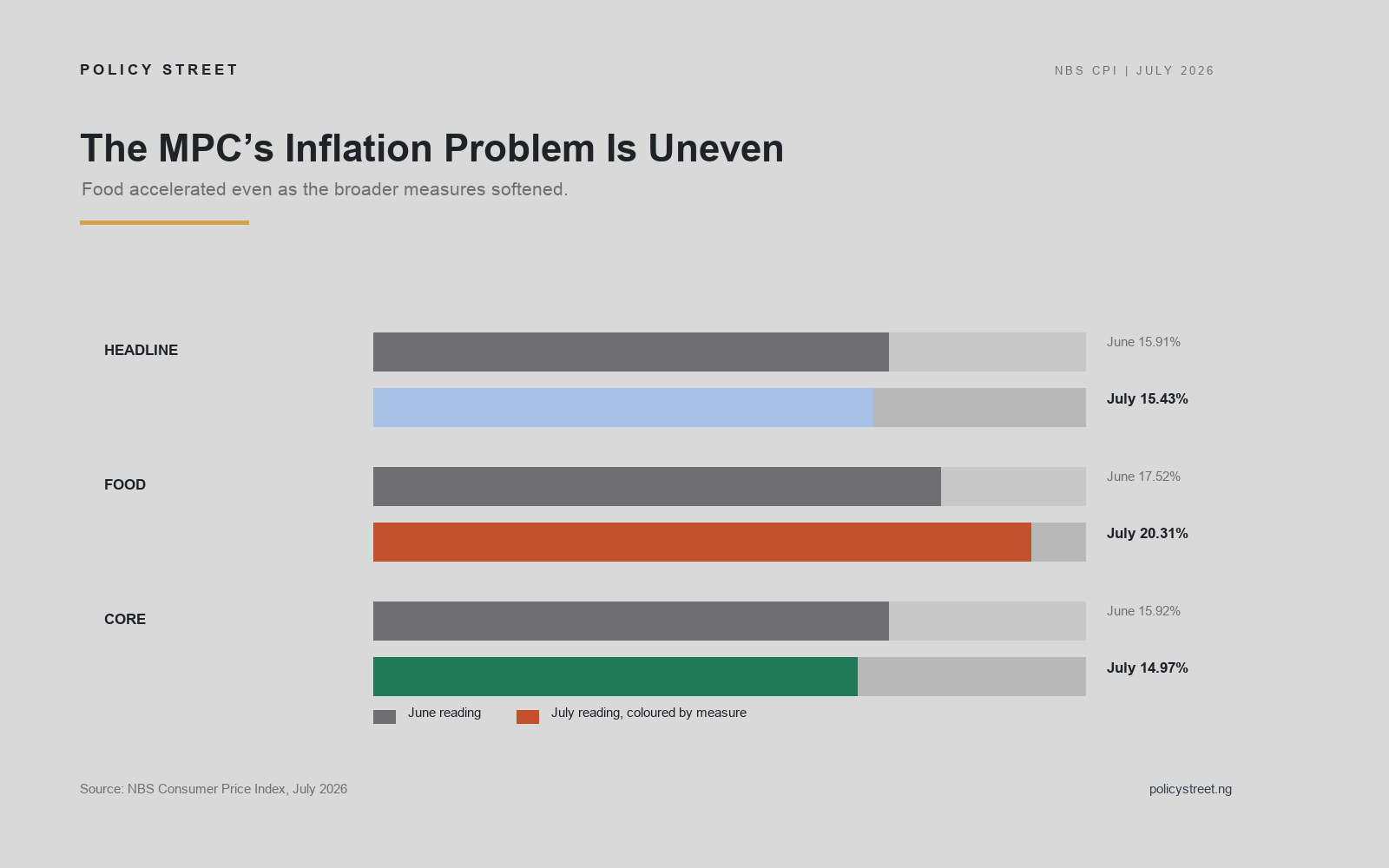
Nigeria's headline inflation fell to 15.43% in July, down from 15.91% in June, according to the National Bureau of Statistics (NBS). This is the second consecutive monthly decline and the lowest reading since March. The same report showed food inflation rising for a sixth consecutive month, with prices up 5.56% between June and July, compared with 3.75% the month before. The Central Bank's Monetary Policy Committee meets on 21–22 September to decide what to do with a rate that has been held at 26.5% for two consecutive meetings. Making sense of that decision requires first separating what these two inflation measures actually track, since the headline number and the food number are not necessarily describing the same thing, even though both come from the same NBS release.
What the Measures Actually Track
Headline inflation measures the year-on-year change in the price of NBS's full consumer basket: rent, transport, healthcare, clothing, and food, weighted by each category's share of average household spending. When NBS says headline inflation "fell to 15.43%" in July, the full basket cost 15.43% more than it did in July 2025, down from 15.91% the month before, itself a comparison against June 2025.
Food carries a large weight in the basket, approximately 40.0% under the NBS's 2025 rebasing, down from 51.8% previously (NBS rebased CPI; Eco215, Feb 2025). Nigerian households also spend an unusually high share of income on food, nearly 60% in 2023, versus roughly 20–26% in Argentina, Colombia, and Mexico, and under 9% in the US and UK (USDA ERS, 2023). That combination is why food-price moves tend to dominate the headline figure more than other categories – though less so now than before the rebasing, since food's weight has shrunk while categories like transport and restaurants grew from approximately 6.5% and 1.2% to 10.7% and 12.9% respectively. That's why the headline number improved even as food inflation worsened: gains in those other, now-larger categories outweighed food's deterioration across the rebalanced basket.
Food inflation itself measures the year-on-year change in NBS's food sub-index specifically, isolated from the rest of the basket. In July, that comparison stood at 20.31%, meaning the food basket cost 20.31% more than it did in July 2025, up from 17.52% in June. The 2.79-percentage-point rise between those two readings reflects the 12-month comparison window moving forward by one month and picking up an unusually strong July on its own Food prices rose 5.56% between June and July, compared with 3.75% the month before, a monthly acceleration of 1.82 percentage points. The NBS attributed the increase to a specific set of items: crayfish, fresh pepper, onions, carrots, rice, water yam, tomatoes, garri, plantain, beef, eggs, guinea corn, ginger, and plantain flour. These are perishables and staples, more exposed to harvest timing and local supply disruption than to the exchange rate or money supply, though NBS's report does not itself state this causal attribution, instead, it identifies the items driving the change without assigning a specific mechanism.
What the Committee Might Weigh
Given what the above measures capture, the relevant question is which one the Committee would likely treat as decisive. Core inflation, the NBS measure that excludes farm produce and energy because those categories are volatile and often disconnected from monetary conditions, fell from 15.92% in June to 14.97% in July, its lowest level since May 2022. Core inflation is therefore moving in the same direction as headline inflation, and faster. Previously, ahead of the MPC's July 2026 meeting, Professor Uche Uwaleke of the Capital Market Academics of Nigeria, argued that a rate decision should depend on "a more persistent and broad-based inflationary trend, especially in core inflation". If the Committee applies that criterion, the July food print does not by itself argue for holding the rate higher: food-price increases driven by harvest timing and supply disruption are not well addressed by an interest rate, which operates through credit conditions rather than through farm output or transport logistics.
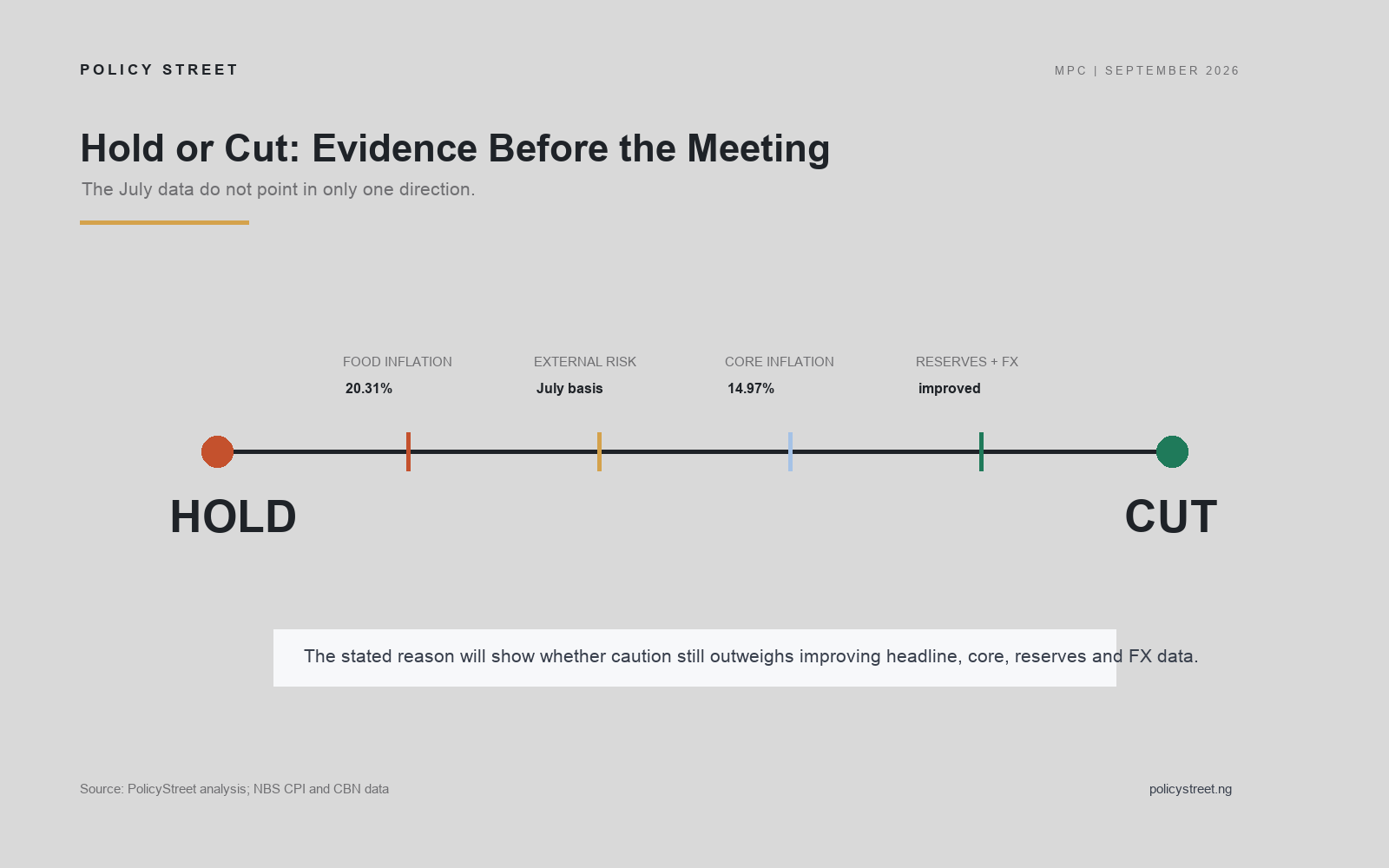
These developments narrow the range of justifications available for holding the rate at 26.5%. The disinflation is broad enough to satisfy Uwaleke's own criterion, the food component driving the headline print is not something monetary policy can address directly in Nigeria, and the currency and reserves rationale that anchored the July hold has itself been overtaken by the reserve build to $54.08 billion (as at 3 Sept 2026, and unlikely to fall as oil prices remain elevated, which supports Nigeria's reserve accumulation through crude-related receipts) and the naira's appreciation into the N1,315 –1,338 range. Both of these are already ahead of the levels the policy was originally set to defend. Although it can be argued that none of this makes a cut automatic, as the Committee may still prefer to build on the gains for another cycle before easing, particularly with food inflation still elevated in absolute terms. A key take is that the balance of evidence has shifted enough since July that a hold would now rest on caution rather than on the data itself. This is particularly so as the same elevated oil prices that support external reserves are also the specific mechanism that pushes food and transport inflation higher.
Where the Governor Stands
Set against this, Governor Olayemi Cardoso has been explicit that recent moderation should not be read as grounds for easing. At BusinessDay's CEO Forum in July, he pointed to "11 months of continuous disinflation" running into early 2026, a reference to the run of declines that continued through February 2026 before inflation began trending upward again, and said that trajectory had been interrupted by renewed conflict in the Middle East. "If not for the fact that we had this," he said, "we had projected that going into next year, inflation would have been down to very moderate levels." At the Committee's 306th meeting on 20–21 July, the MPC held the MPR at 26.5% for a second consecutive meeting, with Cardoso citing the same external-risk framework.
Professional forecasters remain divided on what comes next, and the divide is worth stating precisely rather than blending into a single consensus. Standard Chartered's chief economist for Africa and the Middle East, Razia Khan, has projected the MPR at 25% by year-end, implying roughly 150 basis points of further easing across the remaining 2026 meetings. The Chartered Institute of Bankers of Nigeria (CIBN), through its president Dele Alabi, has taken the opposite position: in comments to the News Agency of Nigeria ahead of the July meeting, Alabi said he expected the Committee to hold, arguing that inflation had "neither increased significantly nor declined sufficiently" to justify a move in either direction, a position CIBN maintained through the July decision. (A specific figure of 25.5% via two 50-basis-point cuts has circulated in connection with CIBN's name; tracing it to source shows it originated as a reader comment beneath a news article covering Alabi's remarks, not as a CIBN or Alabi projection, and is excluded here on that basis.) The genuine disagreement, then, is over direction, not just magnitude.
A Limitation Worth Stating
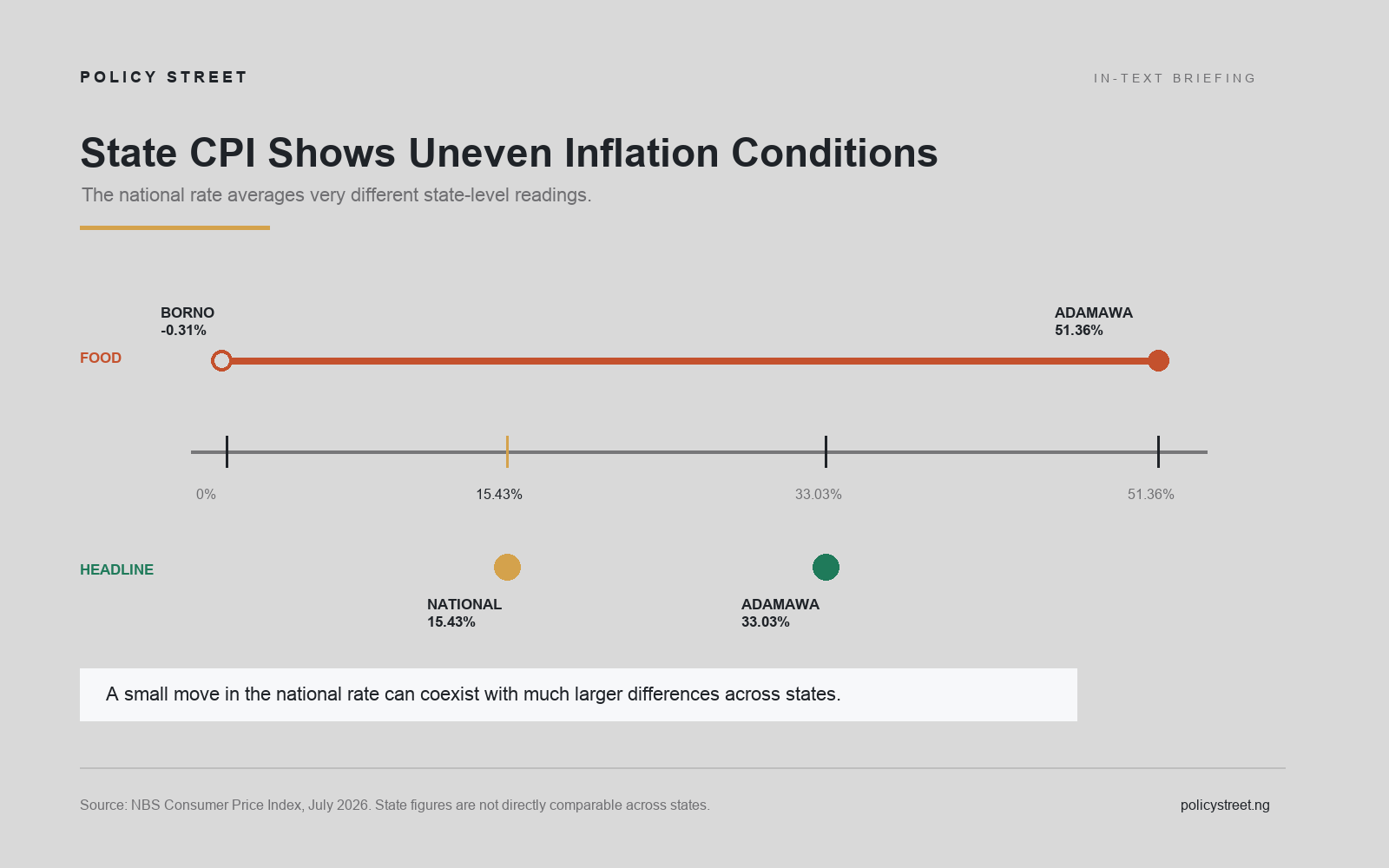
Even setting aside the direction of the September decision, one limitation in the underlying data deserves mention. State-level figures published by the NBS alongside its July 2026 national release show food inflation ranging from −0.31% in Borno to 51.36% in Adamawa on a year-on-year basis, and headline inflation reaching 33.03% in Adamawa; more than double the national rate of 15.43%. The NBS itself cautions against direct state-to-state comparison, since consumption patterns and expenditure weights differ by location. The range nonetheless indicates that the national number, in either direction, represents an average across substantially different regional conditions — conditions that a single national policy rate, applied uniformly, does not address directly. This is not a flaw specific to Nigeria's data; it is a structural feature of any national policy rate applied to a country with Nigeria's degree of regional economic variation. But it is worth stating plainly, because a headline figure moving by half a percentage point can obscure a much larger and more consequential divergence underneath it.
A Note on Timing
One further point of method is worth making explicit, since it bears directly on how much confidence to place in any of the above. As of this writing, the NBS has not yet published its August 2026 CPI report; based on its recent release pattern (the July report was published in mid-August), an August print is expected shortly before the 21–22 September meeting, and, being the most current data point available to the Committee, it may weigh more heavily on the decision than the July figures analyzed here. United Capital Research had projected headline inflation decelerating to roughly 14.82% for August, but that is a forecast, not a data point, and food inflation's sharp July acceleration, driven partly by elevated global oil prices feeding into transport and logistics costs, creates real uncertainty about whether that deceleration will materialize on schedule. Any reader relying on this analysis close to the meeting date should check for the August release before treating the July-based reasoning above as current.
What the Decision Will Actually Reveal
Taken together, the evidence assembled here does not establish which decision the Committee will make on 22 September. It does clarify what each decision would indicate about the Committee's actual reasoning.
A hold that cites the food print would indicate that the Committee is weighting a measure it has previously said should be assessed alongside core inflation, not in place of it. A hold that cites unresolved external risk, consistent with Cardoso's stated position at the July CEO Forum, would follow directly from the Committee's own stated framework, and would be reinforced by forecaster CIBN's continuing hold expectation. A cut, of any size, would indicate that reserve accumulation and currency appreciation have outweighed the food-inflation print in the Committee's assessment, which is consistent with Standard Chartered's forecast, though not with CIBN's.
The reasoning stated in the September communiqué will therefore reveal more about the Committee's actual decision framework than the numerical outcome itself will. A rate that moves without a clearly articulated basis tells an observer very little; a rate that holds, or moves, for a reason consistent with the Committee's own previously stated criteria tells an observer a great deal about how much weight to place on that framework going forward, including at the next meeting, on 23–24 November, when a fresh CPI print and, by then, a clearer picture of the external-risk environment will apply the same test again.
Sources: National Bureau of Statistics, Consumer Price Index reports (June–July 2026); Central Bank of Nigeria, Monetary Policy Committee calendar and decisions (cbn.gov.ng); Central Bank of Nigeria external reserves and NFEM exchange rate data; U.S. Department of Agriculture, Economic Research Service, international food expenditure data; remarks by Governor Olayemi Cardoso at BusinessDay's CEO Forum, July 2026, as reported by BusinessDay; remarks by Uche Uwaleke (Capital Market Academics of Nigeria) and Dele Alabi (Chartered Institute of Bankers of Nigeria) to the News Agency of Nigeria, July 2026; Standard Chartered Plc investment note, Razia Khan, July 2026, as reported by Bloomberg and Businessday.