The rate position
The MPR currently stands at 26.50 percent. Following a tightening cycle that peaked at 27.50 percent, the MPC cut by 50 basis points at its 302nd meeting in September 2025 and by a further 50 basis points at its 304th meeting in February 2026. At the 305th meeting on 19 – 20 May 2026, the committee held all parameters unchanged – MPR, Standing Facilities Corridor, and Cash Reserve Requirement. Total easing delivered to date: 100 basis points across two meetings.
The inflation data
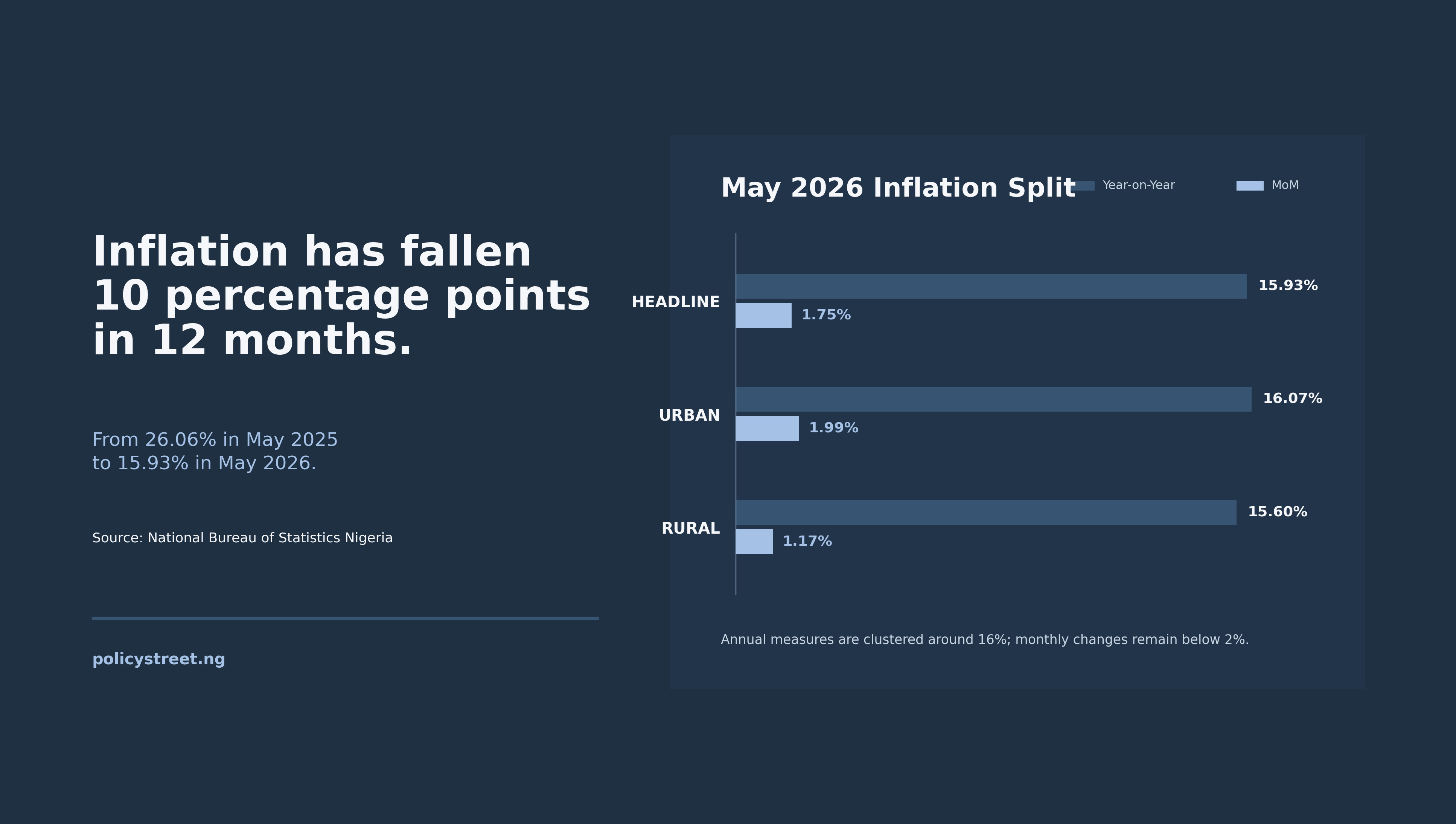
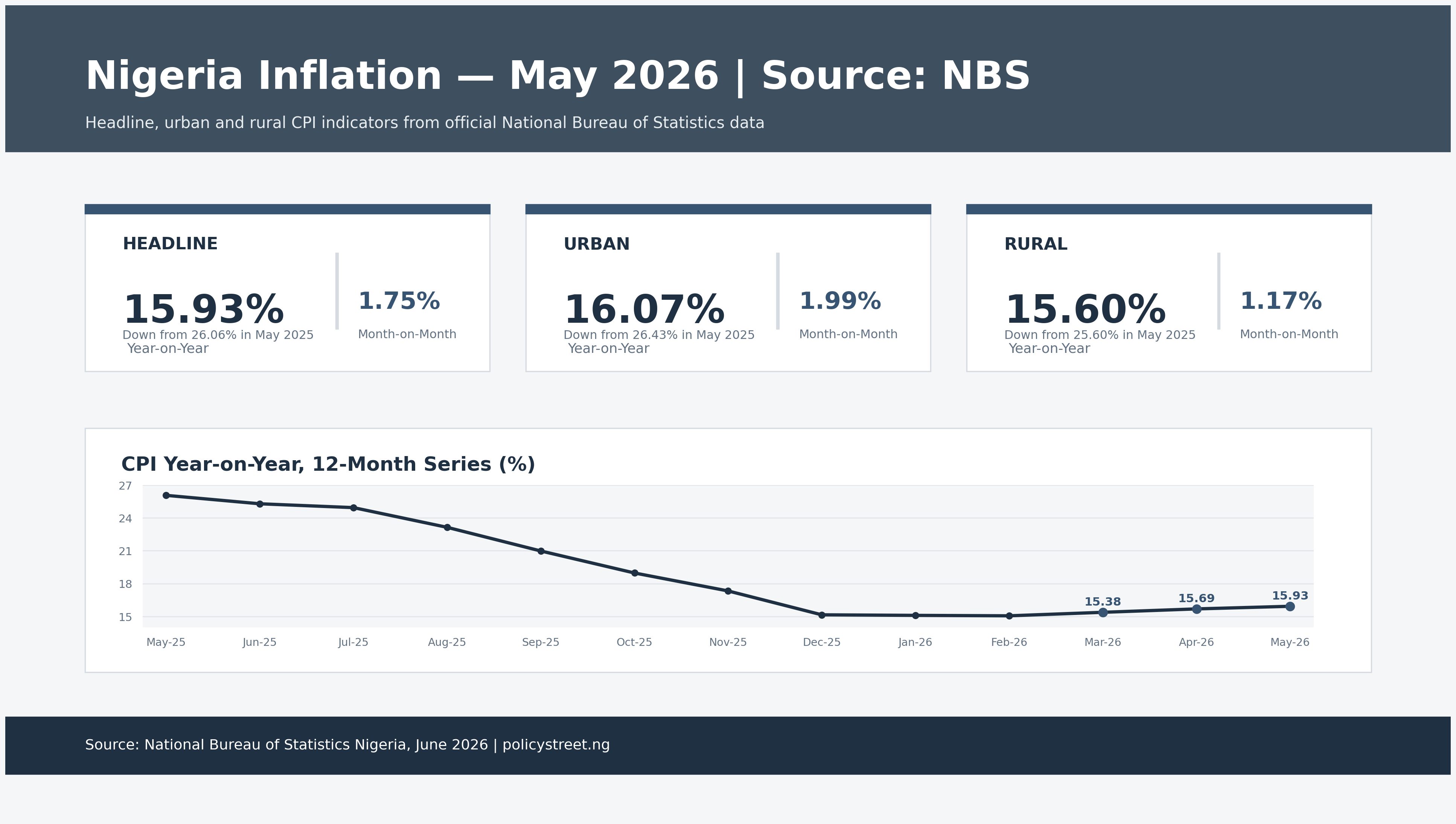
According to the National Bureau of Statistics, headline inflation rose to 15.93 percent year-on-year in May 2026, up from 15.69 percent in April and 15.09 percent in March – the third consecutive monthly increase. The Consumer Price Index stood at 140.7 in May against 138.3 in April.
Food inflation rose to 16.96 percent year-on-year in May from 16.06 percent in April. Core inflation rose to 16.82 percent from 15.86 percent.
The monthly rate tells a different story: month-on-month price growth slowed to 1.75 percent in May from 2.13 percent in April, suggesting the pace of price increases is decelerating even as the annual rate rises. That distinction matters for how the committee frames the trend.
For context, headline inflation in May 2025 was 26.06 percent. The disinflation achieved over twelve months is substantial. The committee's question is whether the three-month uptick represents a temporary external shock or a structural reversal.
The external driver
The IMF's June 2026 Article IV assessment identified the primary source of renewed inflationary pressure as the rise in global fuel, food and fertiliser prices stemming from the Middle East conflict – not domestic monetary conditions. The IMF projected inflation reaching 17 percent year-on-year by end-2026, approximately three percentage points above its pre-conflict projection, and recommended that the CBN maintain a tight monetary policy stance with a data-dependent approach until disinflation is entrenched and inflation expectations are anchored. (IMF Nigeria 2026 Article IV Consultation)
The fiscal dimension
Nigeria's general election is scheduled for January 2027. The IMF's June 2026 assessment called for a neutral fiscal stance to support macroeconomic stability and disinflation, while flagging risks from off-budget spending and complex financing instruments. Pre-election fiscal expansion, if it materialises, would work against the disinflation path the MPC is trying to preserve.(IMF Nigeria 2026 Article IV Consultation).
What the July meeting is actually deciding
A hold at 26.50 percent is the base case consistent with the stated data-dependent framework and the IMF's recommendation. The more consequential output will be the committee's characterisation of the inflation trend – whether the three-month rise is treated as an external, temporary shock or as evidence that the disinflation trajectory is under threat. That framing will effectively set the terms for the September decision.
The committee may also signal adjustments to the Cash Reserve Requirement or Standing Facilities Corridor without moving the headline rate. These instruments carry the operational tightening signal and deserve as much attention as the MPR itself.
Sources: CBN Monetary Policy Decisions, cbn.gov.ng (official); NBS Consumer Price Index Report, May 2026, nigerianstat.gov.ng (official); IMF Nigeria 2026 Article IV Consultation Staff Report, June 2026 (official); CBN MPC Calendar 2026, cbn.gov.ng (official).