The Central Bank of Nigeria's (CBN) Monetary Policy Committee (MPC) meets on 23 and 24 November, following its September decision to reduce the Monetary Policy Rate (MPR) from 26.5 to 23 per cent. The Committee described the reduction as an adjustment to bring its announced interest rate closer to the rates banks were already paying, rather than a decision to make monetary policy less restrictive. Annual headline inflation has since fallen from 15.39 per cent in August to 14.63 per cent in September, while core inflation declined from 13.29 to 12.95 per cent.
Ahead of the September MPC meeting, our earlier PolicyStreet article examined whether the conditions that led the CBN to hold interest rates at 26.5 per cent in July still justified that decision. By early September, those conditions had largely been met: core inflation had declined, external reserves had risen to US$54.08 billion and the naira had strengthened. Our assessment was that the evidence increasingly supported a rate cut, although elevated food inflation remained a reason for caution. The CBN subsequently reduced the MPR by 350 basis points. However, while the improvement in inflation and external conditions supported the decision, the Committee emphasised correcting the gap between its announced policy rate and the interest rates banks were actually paying. It therefore described the reduction primarily as an operational adjustment rather than a change in its monetary policy stance.
At its September meeting, the CBN expected inflation to decline further as earlier interest rate increases continued to affect the economy, the naira remained relatively stable and food supplies improved during the harvest. It also warned that geopolitical tensions and election-related spending could put renewed pressure on prices. The Committee said it would assess whether the revised interest-rate system was working as intended. The November decision will provide an indication of how the Committee has assessed these developments.
The following examines how the CBN may respond at its November MPC meeting.
The September Rate Cut
The September cut was unusual because the CBN’s headline rate was well above what banks were actually paying one another. Before the decision, the Monetary Policy Rate (MPR) stood at 26.5 per cent, yet overnight lending between banks was close to 22 per cent. This implies that the MPR was no longer setting the price of overnight money, and the rate the CBN announced was not the rate that determined banks’ borrowing costs.
The gap between the MPR and overnight lending rates comes from how the CBN steers short-term rates. The MPR is an announced benchmark, not a rate most banks pay. Market rates are normally held between two limits: the Standing Lending Facility (SLF) rate, at which banks can borrow overnight from the CBN, and the Standing Deposit Facility (SDF) rate, at which they can deposit surplus funds with the CBN and earn interest. A bank has little reason to borrow above the first or to lend below the second. Before September, the SDF rate was 22 per cent. With substantial surplus funds in the banking system, banks had little need to borrow, so overnight rates settled near that floor, far below the MPR. The CBN concluded that its main rate had stopped providing an effective guide to borrowing costs.
This does not mean monetary policy was ineffective. Overnight rates near 22 per cent were still well above August inflation of 15.39 per cent, a real rate of about 6.6 percentage points (author’s calculation), and the Cash Reserve Requirement stayed at 45 per cent for deposit money banks. In other words, policy was restrictive, but the deposit floor and the reserve requirement were delivering that restriction, not the MPR. The MPR therefore overstated it: measured against inflation, it implied a real rate of about 11 points.
The chart compares the CBN's interest-rate corridor before and after the September decision. While the MPR and lending ceiling fell by 3.5 percentage points, the deposit floor declined by 2 percentage points. This reduced the gap between the MPR and the deposit floor from 450 to 300 basis points.
Figure 1. The CBN's Interest-Rate Corridor Before and After September 2026
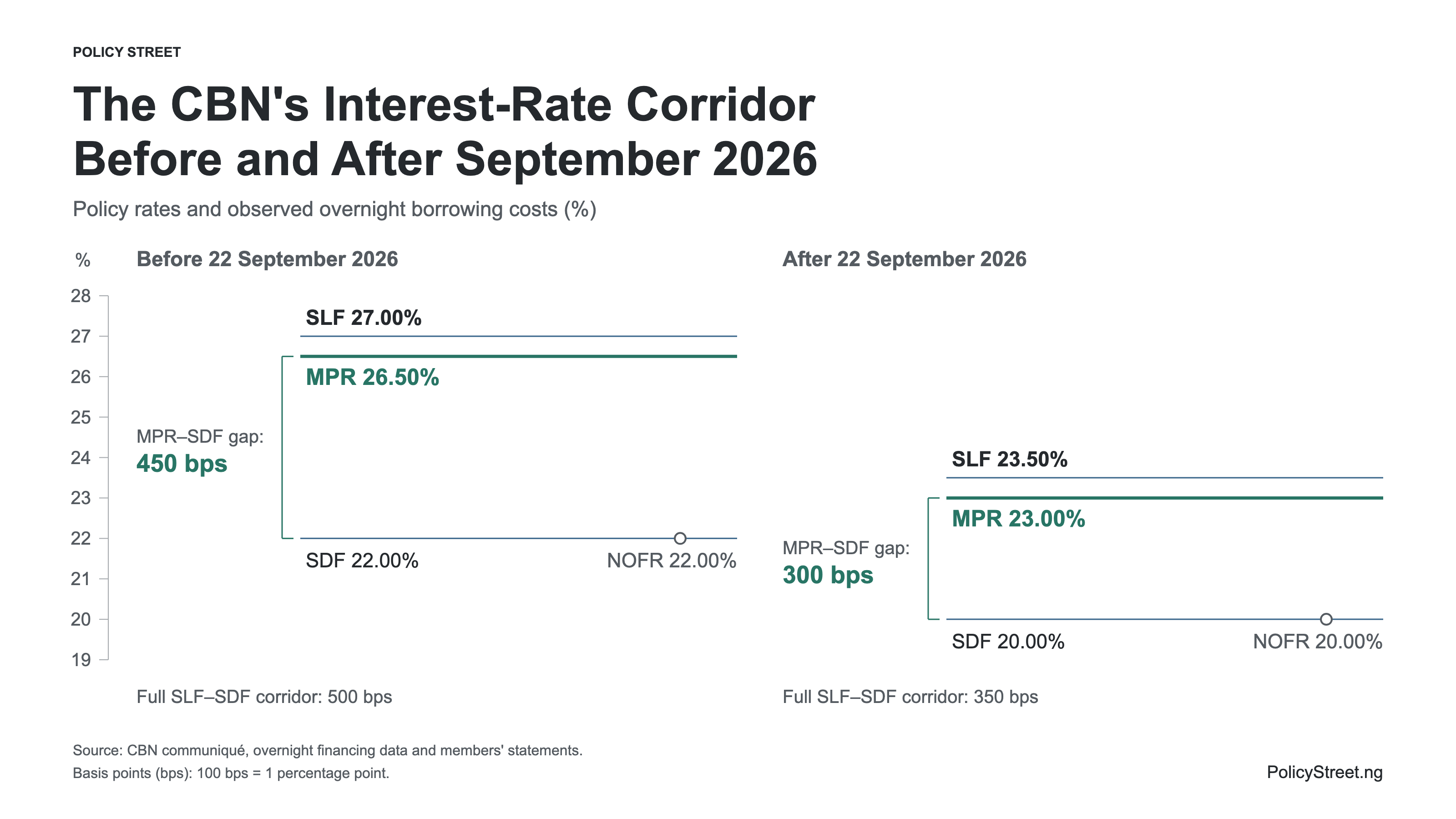
The significance is that banks can now obtain overnight funds at 20 per cent, compared with 22 per cent before September. All else equal, lower funding costs can encourage banks to lend more at lower interest rates, supporting business investment and household spending, although stronger demand may also add to inflationary pressure. Because lending decisions respond partly to actual funding costs, an MPR of 26.5 per cent signalled more restraint than banks were facing. By narrowing the gap between the MPR and overnight borrowing rates, the CBN has made the MPR more representative of actual borrowing conditions. Whether the revised framework has strengthened its influence over borrowing costs beyond the overnight market remains uncertain.
Inflation Since July
Inflation has continued to decline, broadly in line with the Committee's September expectations. However, the annual figures and recent monthly price changes provide different indications of how firmly inflation is moderating.
Figure 2. Annual inflation in Nigeria, September 2025–September 2026
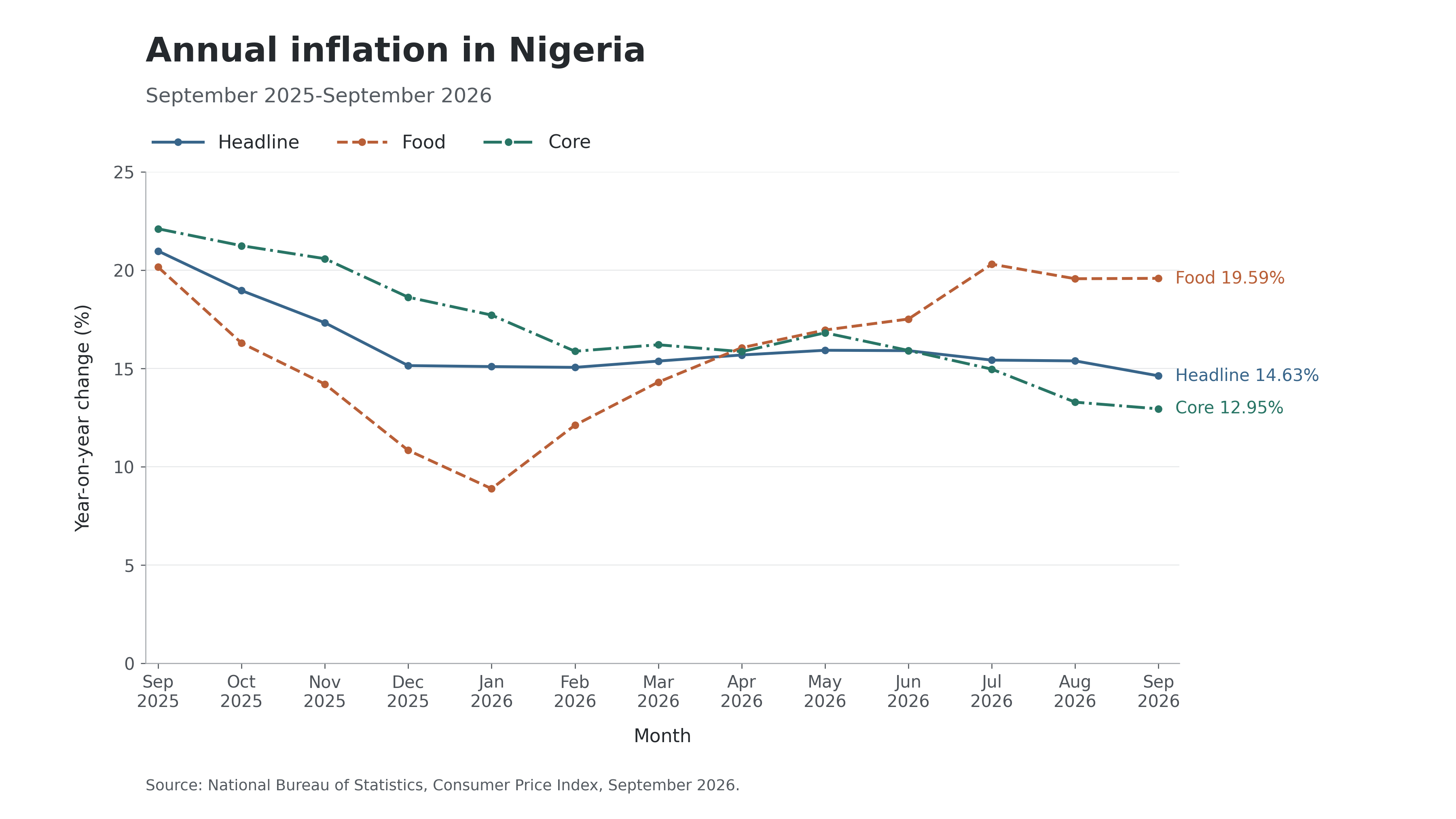
Between July and September, annual headline inflation declined from 15.43 to 14.63 per cent, while core inflation fell from 14.97 to 12.95 per cent. Food inflation remained considerably higher at 19.59 per cent, almost unchanged from August's 19.57 per cent. Consumer prices were therefore still rising compared with a year earlier, although the overall rate of increase had slowed.
The longer series also shows that the improvement has not been uniform. Core inflation has declined substantially. Annual food inflation rose during much of 2026 before easing in August and remaining almost unchanged in September. Lower inflation outside food does not necessarily mean that households are experiencing comparable relief in food prices.
Figure 3. Monthly inflation in Nigeria, September 2025–September 2026
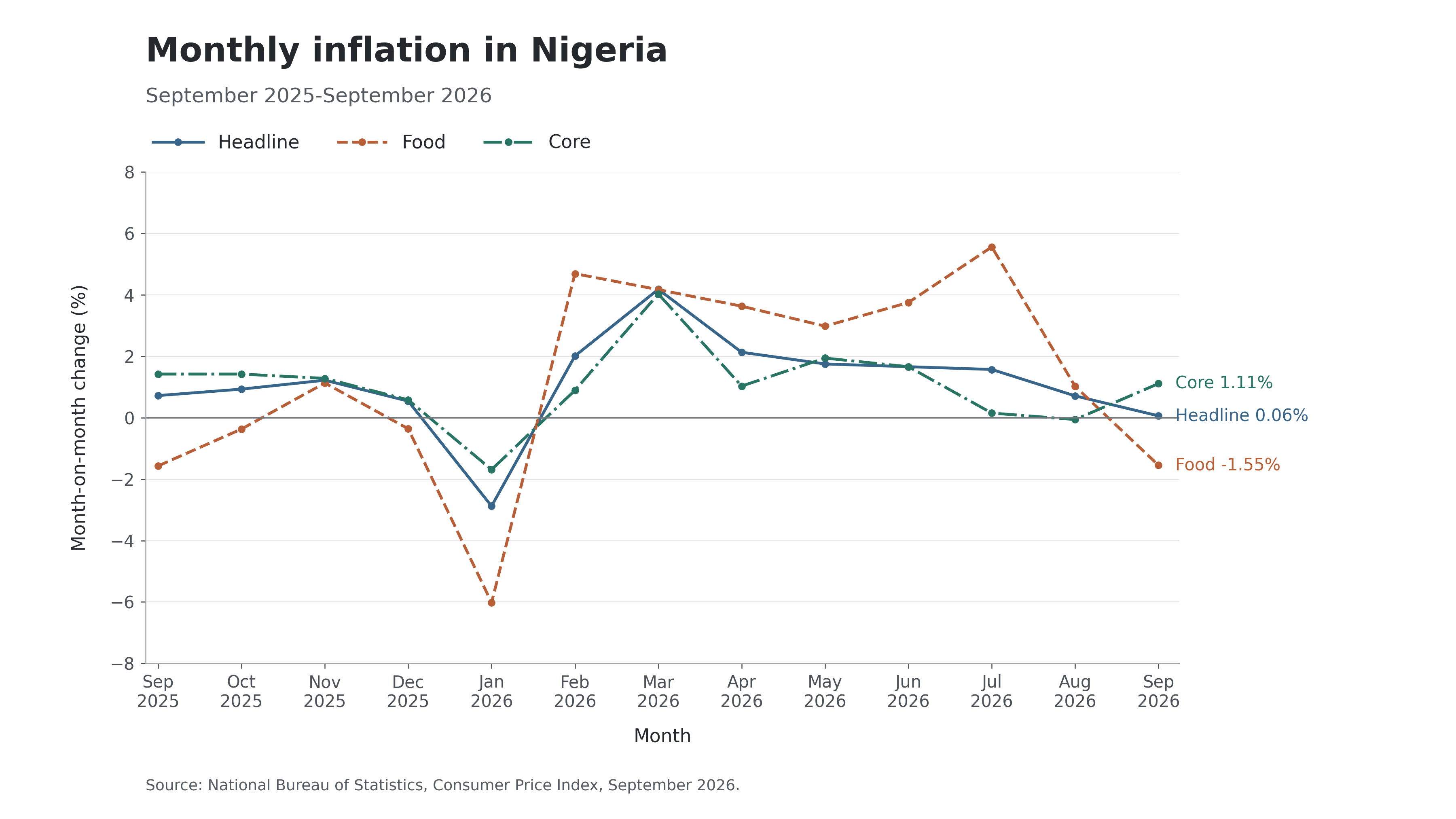
Unlike annual inflation, which compares prices with the same month a year earlier, monthly inflation measures changes from the preceding month. The monthly figures provide a less uniform picture. Headline inflation slowed from 1.57 per cent in July to 0.71 per cent in August and just 0.06 per cent in September. Food prices fell by 1.55 per cent in September, while core prices increased by 1.11 per cent after declining by 0.06 per cent in August.
The increase in monthly core inflation indicates renewed price increases in goods and services outside farm produce and energy. However, one month is insufficient to establish that the downward inflation trend has reversed. The October figures will help determine whether September's increase was temporary or the beginning of renewed inflationary pressure.
Figure 4. Core inflation in Nigeria, July–September 2026
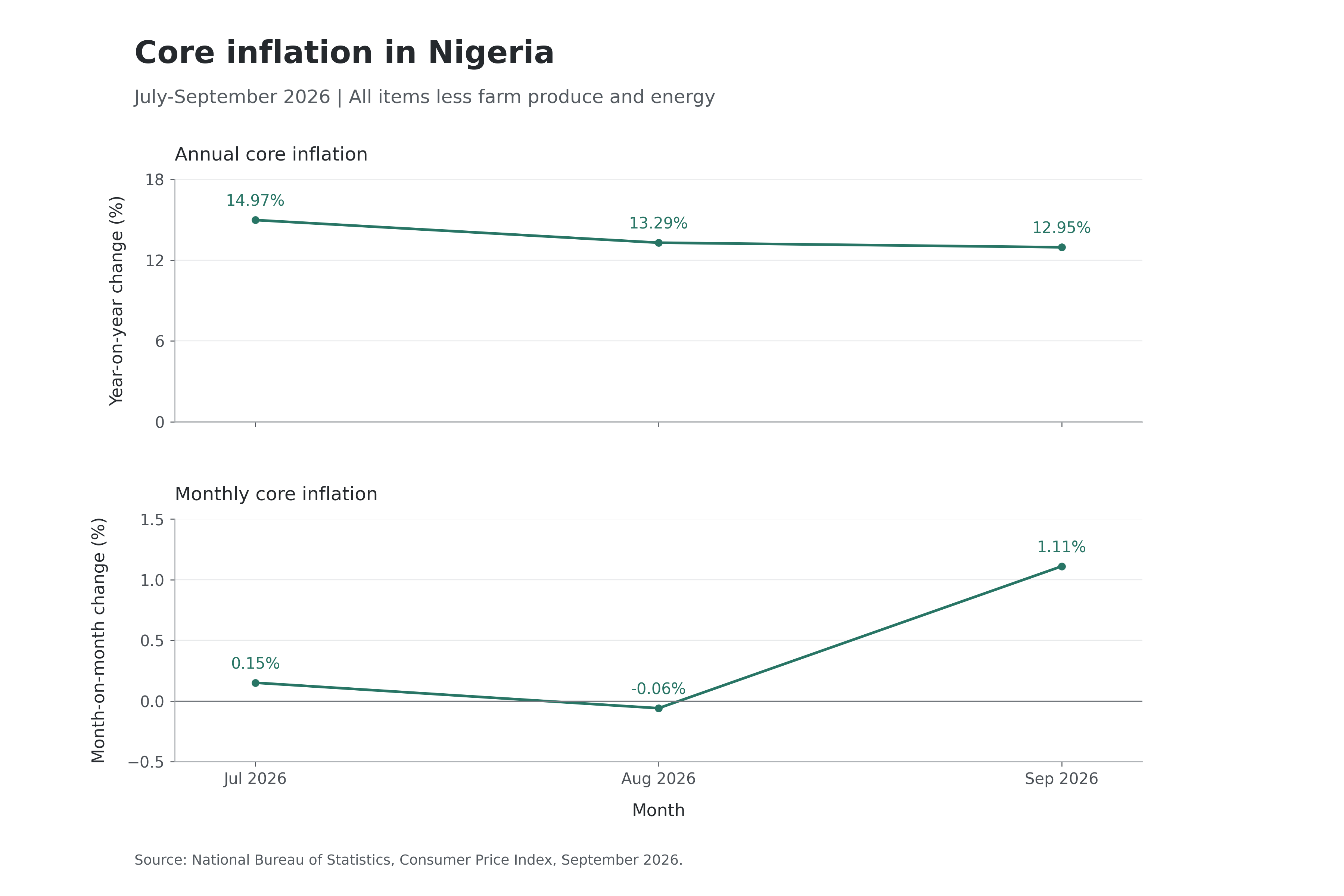
Figure 4 illustrates why annual and monthly inflation can move in different directions. Annual core inflation declined from 13.29 per cent in August to 12.95 per cent in September, even though monthly core inflation increased. The annual rate depends partly on the price movement in the corresponding month of the previous year. September 2026's monthly core increase of 1.11 per cent was below the 1.42 per cent recorded in September 2025. Replacing the larger monthly increase from a year earlier with a smaller one is consistent with a decline in the annual rate.
The September figures also reveal differences within the consumer price index. Farm-produce prices fell by 2.86 per cent, while energy prices increased by 5.38 per cent. Farm produce accounts for approximately 26.61 per cent of the CPI basket, energy for 6.42 per cent and the core component for 66.99 per cent. These weights help explain why falling farm-produce prices could substantially offset increases elsewhere, leaving overall monthly inflation close to zero.
The decline in food prices is consistent with the CBN's expectation that the harvest would improve supply. Nevertheless, annual food inflation remained close to 20 per cent. Seasonal improvements may reduce prices temporarily without resolving the production and distribution problems that keep food costs elevated.
The evidence therefore supports continued disinflation, although the increase in monthly core inflation raises questions about its persistence. September's figures warrant caution rather than an immediate reversal of policy. Further moderation in core inflation, alongside sustained improvement in food prices, would strengthen the case for lower interest rates.
The Naira and Inflation Risks
Exchange-rate stability was another condition the CBN expected to support lower inflation. A weaker naira increases the domestic cost of imported goods and production inputs, potentially raising consumer prices.
Nigeria's external position improved ahead of the September meeting. The current-account surplus increased from US$4.49 billion in the first quarter to US$7.54 billion in the second quarter. The gross component of the CBN's daily-published, 30-day-moving-average reserves series also shows reserves rising from US$53.81 billion at the end of August to US$55.22 billion at the end of October, before declining to US$54.93 billion on 9 November.
Table 1. Nigeria's external position and energy indicators, selected periods in 2026
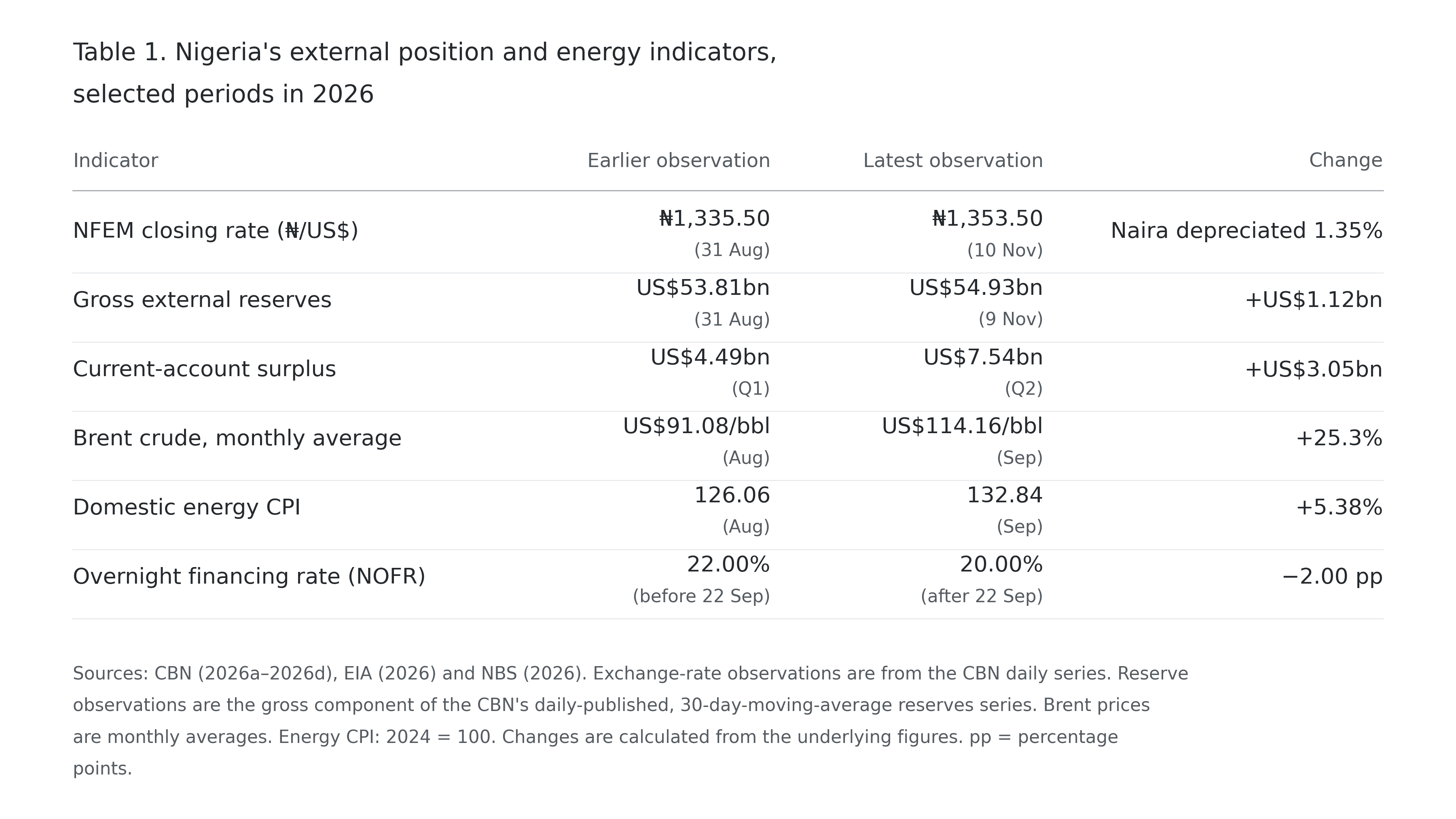
Sources: CBN, EIA and NBS. Exchange-rate observations are from the CBN daily series. Reserve observations are the gross component of the CBN's daily-published, 30-day-moving-average reserves series. Brent prices are monthly averages. Energy CPI: 2024 = 100. Changes are calculated from the underlying figures. pp = percentage points.
The naira weakened modestly over the period. The CBN's Nigerian Foreign Exchange Market closing rate moved from ₦1,335.50 per dollar on 31 August to ₦1,346.00 on 30 October and ₦1,353.50 on 10 November. This represents depreciation of approximately 1.35 per cent since the end of August. The movement does not establish renewed exchange-rate instability, but further depreciation could weaken one of the conditions supporting lower inflation.
International energy prices present another risk. Brent crude averaged US$91.08 per barrel in August and US$114.16 in September, an increase of approximately 25 per cent. Higher crude prices may support Nigeria's export earnings, but they can also increase domestic fuel and production costs.
Domestic energy prices were already rising in September. The NBS energy index increased by 5.38 per cent during the month. On 9 October, NNPC Limited acknowledged higher petrol prices associated with the Middle East conflict and confirmed that a temporary discount at its retail stations would continue until 31 October. A comparable official national petrol-price series for August to October was not verified.
These developments create uncertainty about the persistence of disinflation. Higher energy costs could affect transport, production and distribution prices, although the extent of any further increase in consumer prices remains uncertain. Food prices also require attention: September's monthly decline was encouraging, but annual food inflation remained close to 20 per cent.
The Committee additionally identified election-related spending as a potential source of inflationary pressure. No comparable official measure of such spending since September was verified, so there is insufficient evidence to conclude that it has already increased inflationary pressure.
What MPC Members Said About Future Rates
MPC members agreed on September's decision but differed in how they interpreted the evidence and what it might mean for future interest rates.
Emem Usoro regarded the adjustment as a one-off reset rather than the beginning of an aggressive easing cycle. Governor Olayemi Cardoso similarly emphasised that the decision corrected a weakness in the CBN's operating framework without changing its commitment to restrictive monetary policy.
Other members placed greater weight on the improvement in inflation and the economic costs of maintaining high interest rates. Lamido Yuguda argued that disinflation and stronger external reserves provided room for gradual easing. Philip Ikeazor considered lower rates consistent with supporting productive borrowing, while Mustapha Akinkunmi judged that the improvement in inflation had become sufficiently broad and persistent to justify changing his previous position.
Aloysius Ordu also recognised the scope for adjustment but emphasised that monetary policy might need to remain restrictive for longer if inflation proved persistent. The disagreement was therefore partly about how much confidence members should place in the recent decline in inflation, rather than whether inflation had declined.
The inflation-adjusted policy rate provides another consideration. At an MPR of 23 per cent and September headline inflation of 14.63 per cent, the difference was 8.37 percentage points, compared with 7.61 percentage points when the same 23 per cent MPR is measured against August inflation. This calculation uses current rather than expected inflation and is not a complete measure of monetary restraint. Nevertheless, declining inflation has increased the gap between the policy rate and the observed annual inflation rate (author's calculation).
The November Decision
On the evidence available at the information cut-off, maintaining the MPR at 23 per cent has the stronger justification. Annual inflation has continued to decline, but the increase in monthly core inflation, persistent annual food inflation and higher energy costs leave uncertainty about whether the improvement will continue. September's reduction was also primarily operational, and its effects on borrowing costs beyond the overnight market remain uncertain.
There is a reasonable argument for further easing. With the MPR unchanged at 23 per cent, the difference between the policy rate and annual headline inflation has widened. This suggests that monetary conditions may be becoming more restrictive as inflation declines, potentially increasing the costs of borrowing and investment. However, the MPR is not necessarily the rate banks actually pay, and the difference between the MPR and current inflation is not a sufficient measure of the real interest rate. The case for easing must therefore consider actual market rates and expected inflation, not only the announced policy rate.
The September monthly core figure should not carry enough weight on its own to justify higher interest rates. One observation cannot establish a reversal in inflation. Equally, it weakens the argument for another immediate reduction when food inflation remains elevated and the effects of September's decision are still being assessed.
A further cut would become easier to justify if subsequent figures showed continued moderation in monthly core inflation, sustained improvement in food prices and exchange-rate stability. Evidence that the revised interest-rate corridor was functioning effectively would also help the Committee assess whether another change in the MPR was warranted.
An increase would require stronger evidence of renewed inflationary pressure, such as persistent acceleration in core prices, a material deterioration in the exchange rate or sustained increases in domestic costs that threatened the inflation outlook.
For November, the balance of evidence favours holding the MPR at 23 per cent while assessing whether September's improvement in inflation persists. The case for lower rates has strengthened compared with earlier in the year, but the available evidence does not yet establish that another reduction is necessary at this meeting.
References
Central Bank of Nigeria Monetary Policy Communiqué No. 164, 307th Meeting of the Monetary Policy Committee, 22 September 2026. Abuja: CBN. Official communiqué.
Central Bank of Nigeria Movement in Foreign Reserves, gross component of the daily-published, 30-day-moving-average reserves series. Abuja: CBN. Official reserves data.
Central Bank of Nigeria Nigerian Foreign Exchange Market Rates, daily closing rates. Abuja: CBN. Official exchange rates.
Central Bank of Nigeria Nigerian Overnight Financing Rate, daily series. Abuja: CBN. Official NOFR data.
Central Bank of Nigeria Personal Statements of Members for the 307th Meeting of the MPC, September 2026. Abuja: CBN. Official members' statements.
Energy Information Administration Europe Brent Spot Price FOB, Monthly Series. Washington, DC: US Department of Energy. Official monthly series.
National Bureau of Statistics Consumer Price Index, September 2026, including accompanying statistical workbook. Abuja: NBS. Official CPI data.
NNPC Limited NNPC Discount Offers Relief, Does Not Restore Subsidy, 9 October. Official press release.
Onwordi, E. G. 'Nigeria's Central Bank Meets on 21–22 September as One Inflation Report Sends Different Signals', PolicyStreet. Previous article.
Information cut-off: 10 November 2026. The inflation analysis uses the updated NBS CPI series. CBN exchange-rate and NOFR observations, and the gross component of the CBN's daily-published, 30-day-moving-average reserves series, were taken from official exports retrieved on 11 November, restricted to observations dated on or before the cut-off. The CBN's September communiqué reports reserves of US$55.25 billion on 18 September, whereas that reserves series records US$54.72 billion for that date. The reason for the difference has not been established; comparisons in this article use that reserves series consistently.